Event submissions
Published
This submission belongs to the session S3. Terrestrial and Marine Biodiversity and Habitat Loss Prevention of the event The 1st International Online Conference on Environments
Published date
27 Feb, 2026
Academic Editor
'%3e%3cpath%20d='M12.6657%2010.9104C12.4185%2010.325%2012.0599%209.79327%2011.6097%209.34482C11.1609%208.89508%2010.6293%208.5365%2010.0442%208.28888C10.0389%208.28626%2010.0337%208.28495%2010.0285%208.28233C10.8446%207.69279%2011.3752%206.73249%2011.3752%205.64904C11.3752%203.8542%209.92103%202.39999%208.1262%202.39999C6.33136%202.39999%204.87715%203.8542%204.87715%205.64904C4.87715%206.73249%205.40774%207.69279%206.22393%208.28364C6.21869%208.28626%206.21345%208.28757%206.20821%208.29019C5.62129%208.5378%205.09463%208.89284%204.64265%209.34613C4.1929%209.79493%203.83432%2010.3266%203.58671%2010.9117C3.34345%2011.4845%203.21226%2012.0987%203.20023%2012.7209C3.19988%2012.7349%203.20233%2012.7488%203.20744%2012.7619C3.21255%2012.7749%203.22022%2012.7867%203.22998%2012.7968C3.23975%2012.8068%203.25142%2012.8147%203.26431%2012.8202C3.2772%2012.8256%203.29105%2012.8284%203.30504%2012.8284H4.09109C4.14874%2012.8284%204.19459%2012.7825%204.1959%2012.7262C4.2221%2011.7148%204.62823%2010.7676%205.34617%2010.0497C6.08899%209.30683%207.0755%208.89808%208.1262%208.89808C9.17689%208.89808%2010.1634%209.30683%2010.9062%2010.0497C11.6242%2010.7676%2012.0303%2011.7148%2012.0565%2012.7262C12.0578%2012.7838%2012.1037%2012.8284%2012.1613%2012.8284H12.9474C12.9613%2012.8284%2012.9752%2012.8256%2012.9881%2012.8202C13.001%2012.8147%2013.0126%2012.8068%2013.0224%2012.7968C13.0322%2012.7867%2013.0398%2012.7749%2013.0449%2012.7619C13.0501%2012.7488%2013.0525%2012.7349%2013.0522%2012.7209C13.0391%2012.0947%2012.9094%2011.4855%2012.6657%2010.9104ZM8.1262%207.9024C7.52486%207.9024%206.9589%207.6679%206.53312%207.24211C6.10733%206.81633%205.87283%206.25037%205.87283%205.64904C5.87283%205.0477%206.10733%204.48174%206.53312%204.05596C6.9589%203.63018%207.52486%203.39567%208.1262%203.39567C8.72753%203.39567%209.29349%203.63018%209.71927%204.05596C10.1451%204.48174%2010.3796%205.0477%2010.3796%205.64904C10.3796%206.25037%2010.1451%206.81633%209.71927%207.24211C9.29349%207.6679%208.72753%207.9024%208.1262%207.9024Z'%20fill='%235D1EE1'/%3e%3c/g%3e%3c/svg%3e) Claudio Agnisola
Claudio AgnisolaCitation
Panchali Sengupta, Does beta diversity influence species structure and composition? A study on limenitinae butterflies (Family: Nymphalidae) along an elevational gradient in the Eastern Himalayan Landscape of West Bengal, India., in Proceedings of The 1st International Online Conference on Environments, 2 March–4 March 2026, MDPI: Basel, Switzerland
Share
Email
Facebook
Twitter
LinkedIn
Does beta diversity influence species structure and composition? A study on limenitinae butterflies (Family: Nymphalidae) along an elevational gradient in the Eastern Himalayan Landscape of West Bengal, India.
'%3e%3cpath%20d='M12.6647%2010.9104C12.4176%2010.325%2012.0589%209.7933%2011.6088%209.34485C11.16%208.89511%2010.6283%208.53653%2010.0432%208.28891C10.038%208.28629%2010.0327%208.28498%2010.0275%208.28236C10.8437%207.69282%2011.3743%206.73252%2011.3743%205.64907C11.3743%203.85423%209.92005%202.40002%208.12522%202.40002C6.33038%202.40002%204.87618%203.85423%204.87618%205.64907C4.87618%206.73252%205.40677%207.69282%206.22296%208.28367C6.21772%208.28629%206.21248%208.2876%206.20724%208.29022C5.62031%208.53783%205.09365%208.89287%204.64167%209.34616C4.19192%209.79496%203.83334%2010.3266%203.58573%2010.9117C3.34247%2011.4846%203.21128%2012.0987%203.19925%2012.721C3.1989%2012.735%203.20135%2012.7489%203.20646%2012.7619C3.21157%2012.7749%203.21924%2012.7868%203.22901%2012.7968C3.23877%2012.8068%203.25045%2012.8148%203.26334%2012.8202C3.27623%2012.8256%203.29007%2012.8284%203.30406%2012.8284H4.09012C4.14776%2012.8284%204.19362%2012.7825%204.19493%2012.7262C4.22113%2011.7148%204.62726%2010.7676%205.34519%2010.0497C6.08802%209.30686%207.07452%208.89811%208.12522%208.89811C9.17592%208.89811%2010.1624%209.30686%2010.9052%2010.0497C11.6232%2010.7676%2012.0293%2011.7148%2012.0555%2012.7262C12.0568%2012.7839%2012.1027%2012.8284%2012.1603%2012.8284H12.9464C12.9604%2012.8284%2012.9742%2012.8256%2012.9871%2012.8202C13%2012.8148%2013.0117%2012.8068%2013.0214%2012.7968C13.0312%2012.7868%2013.0389%2012.7749%2013.044%2012.7619C13.0491%2012.7489%2013.0515%2012.735%2013.0512%2012.721C13.0381%2012.0947%2012.9084%2011.4856%2012.6647%2010.9104ZM8.12522%207.90243C7.52388%207.90243%206.95792%207.66793%206.53214%207.24215C6.10636%206.81636%205.87185%206.2504%205.87185%205.64907C5.87185%205.04773%206.10636%204.48177%206.53214%204.05599C6.95792%203.63021%207.52388%203.3957%208.12522%203.3957C8.72655%203.3957%209.29252%203.63021%209.7183%204.05599C10.1441%204.48177%2010.3786%205.04773%2010.3786%205.64907C10.3786%206.2504%2010.1441%206.81636%209.7183%207.24215C9.29252%207.66793%208.72655%207.90243%208.12522%207.90243Z'%20fill='%235D1EE1'/%3e%3c/g%3e%3c/svg%3e)
Panchali Sengupta 1
1. Department of Zoology, West Bengal State University, Berunanpukaria, Malikapur, Barasat, West Bengal, India, India
Abstract
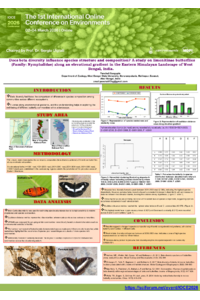
Beta diversity facilitates the comparison of difference in species composition among communities across different ecosystems. It varies along environmental gradients, and this understanding helps in exploring the well-being of different butterfly communities within a landscape. The present study investigates the community composition (beta diversity patterns) of limenitinae butterflies along an elevational gradient. Six elevational belts (˂=1500 masl, 1501-2000 masl, 2001-2500 masl, 2501-3000 masl, 3001-3500 masl, ˃=3501 masl) were established in the surrounding regions outside the jurisdiction of the protected areas of Eastern Himalayas. Bray–Curtis dissimilarity was used for estimating species abundance due to its high sensitivity to relative abundance and species composition. Euclidean distance metrics represented dissimilarities between data points. UPGMA was employed for grouping similar communities hierarchically based on shared characters such as environmental variables of habitat. The turnover component of beta-diversity demonstrated species replacement from one site to another, while nestedness highlighted the occurrence of species-poor assemblages as subsets of more species-rich communities. Additionally, Sorenson similarity measured the degree of overlap in species composition between two communities across the elevational gradient. Significantly, beta diversity was estimated at two levels: stepwise beta diversity and pairwise beta diversity. Stepwise beta diversity formed a peak between 3001-3500 masl (0.360), indicating the highest species dissimilarity. However, pairwise beta diversity showed a consistent increase in dissimilarity with an increase in distance between two elevation bands, favoring the distance-decay hypothesis. These higher values are probably indicative of the substitution of species components, suggesting species occurrence exclusively in each elevation belt. Euclidean distance metrics reached the highest value between 2001 to 2500 masl (40.575). The highest species turnover (7.000), nestedness in species occurrence (0.621), and Sorenson’s similarity (0.318) were recorded between 3001 to 3500 masl. Besides beta diversity, turnover due to environmental constraints could be associated with changes in community structure across the study site.
Keywords
beta diversity
Bray-Curtis dissimilarity
Euclidean distance
nestedness
turnover
Sorenson’s similarity
Poster
Sengupta_sciforum158106.pdf
Energy, Economic, and Environmental (Triple-E) Analysis of Energy Recovery from Sewage Sludge in Municipal Wastewater Treatment Plants
Degradation of Sulfamethazine and Trimethoprim in Aquaculture Wastewaters: Kinetics, Pathogen Inactivation, and Toxicity Assessment