Event submissions
Published
This submission belongs to the session S1. Environmental Assessment Methods and Management Technologies of the event The 1st International Online Conference on Environments
Published date
27 Feb, 2026
Academic Editor
'%3e%3cpath%20d='M12.6657%2010.9104C12.4185%2010.325%2012.0599%209.79327%2011.6097%209.34482C11.1609%208.89508%2010.6293%208.5365%2010.0442%208.28888C10.0389%208.28626%2010.0337%208.28495%2010.0285%208.28233C10.8446%207.69279%2011.3752%206.73249%2011.3752%205.64904C11.3752%203.8542%209.92103%202.39999%208.1262%202.39999C6.33136%202.39999%204.87715%203.8542%204.87715%205.64904C4.87715%206.73249%205.40774%207.69279%206.22393%208.28364C6.21869%208.28626%206.21345%208.28757%206.20821%208.29019C5.62129%208.5378%205.09463%208.89284%204.64265%209.34613C4.1929%209.79493%203.83432%2010.3266%203.58671%2010.9117C3.34345%2011.4845%203.21226%2012.0987%203.20023%2012.7209C3.19988%2012.7349%203.20233%2012.7488%203.20744%2012.7619C3.21255%2012.7749%203.22022%2012.7867%203.22998%2012.7968C3.23975%2012.8068%203.25142%2012.8147%203.26431%2012.8202C3.2772%2012.8256%203.29105%2012.8284%203.30504%2012.8284H4.09109C4.14874%2012.8284%204.19459%2012.7825%204.1959%2012.7262C4.2221%2011.7148%204.62823%2010.7676%205.34617%2010.0497C6.08899%209.30683%207.0755%208.89808%208.1262%208.89808C9.17689%208.89808%2010.1634%209.30683%2010.9062%2010.0497C11.6242%2010.7676%2012.0303%2011.7148%2012.0565%2012.7262C12.0578%2012.7838%2012.1037%2012.8284%2012.1613%2012.8284H12.9474C12.9613%2012.8284%2012.9752%2012.8256%2012.9881%2012.8202C13.001%2012.8147%2013.0126%2012.8068%2013.0224%2012.7968C13.0322%2012.7867%2013.0398%2012.7749%2013.0449%2012.7619C13.0501%2012.7488%2013.0525%2012.7349%2013.0522%2012.7209C13.0391%2012.0947%2012.9094%2011.4855%2012.6657%2010.9104ZM8.1262%207.9024C7.52486%207.9024%206.9589%207.6679%206.53312%207.24211C6.10733%206.81633%205.87283%206.25037%205.87283%205.64904C5.87283%205.0477%206.10733%204.48174%206.53312%204.05596C6.9589%203.63018%207.52486%203.39567%208.1262%203.39567C8.72753%203.39567%209.29349%203.63018%209.71927%204.05596C10.1451%204.48174%2010.3796%205.0477%2010.3796%205.64904C10.3796%206.25037%2010.1451%206.81633%209.71927%207.24211C9.29349%207.6679%208.72753%207.9024%208.1262%207.9024Z'%20fill='%235D1EE1'/%3e%3c/g%3e%3c/svg%3e) Milena Horvat
Milena HorvatCitation
Alexandra A. Ioannidi, Maria Antonopoulou, Dionissios Mantzavinos, Degradation of Sulfamethazine and Trimethoprim in Aquaculture Wastewaters: Kinetics, Pathogen Inactivation, and Toxicity Assessment, in Proceedings of The 1st International Online Conference on Environments, 2 March–4 March 2026, MDPI: Basel, Switzerland
Share
Email
Facebook
Twitter
LinkedIn
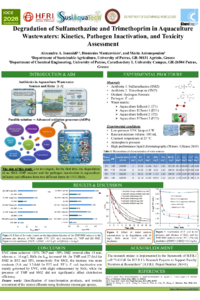
Degradation of Sulfamethazine and Trimethoprim in Aquaculture Wastewaters: Kinetics, Pathogen Inactivation, and Toxicity Assessment

Alexandra A. Ioannidi 1,2

Dionissios Mantzavinos 1

Maria Antonopoulou 3
1. Department of Chemical Engineering, University of Patras, Caratheodory 1, University Campus, GR-26504 Patras, Greece, Greece
2. Department of Sustainable Agriculture, University of Patras, 30131 Agrinio, Greece
3. Department of Sustainable Agriculture, University of Patras, 30131 Agrinio, Greece, Greece
Abstract
Antibiotics like sulfamethazine (SMZ) and trimethoprim (TMP) are widely used in aquaculture to treat bacterial infections in farmed fish. Their extensive use results in continuous release into wastewater, where they persist as micropollutants. Both compounds show low biodegradability and can accumulate in water bodies. Their presence in aquaculture effluents raises concerns about antimicrobial resistance, ecotoxicity to aquatic organisms, and potential human exposure through water reuse and seafood consumption.
Because of their persistence, advanced oxidation processes such as UVC/H₂O₂, solar/persulfate, and ozone are increasingly examined to efficiently degrade these antibiotics and minimize toxic transformation products. In this study, to the best of our knowledge, the degradation of an SMZ–TMP mixture in aquaculture influents and effluents from two different farms was investigated by UVC/H₂O₂ for the first time. Experiments were conducted in a 150 mL batch reactor using a low-pressure UVC lamp at 8 W and a temperature of 25 °C. SMZ and TMP concentrations were monitored using high-performance liquid chromatography (HPLC, Waters Alliance 2695, Milford, MA, USA). All water samples exhibited TSS and TOC below 6 and 3 mg/L, respectively, with pH 7.7–7.9 and conductivity of 350–430 μS/cm.
Preliminary experiments show very promising results. Specifically, photolysis experiments showed that UVC alone cannot degrade TMP, achieving less than 15% removal at 10 min, while SMZ exhibited a removal of ~50% at the same time. Remarkably, in the presence of 7 mg/L H₂O₂, the UVC/H₂O₂ process achieved more than 50% TMP and 90% SMZ removal at 15 min. The next steps include simultaneous antibiotic removal and pathogen inactivation, and toxicity assessment of the treated effluents using freshwater (Chlorococcum sp.) and saltwater (Tisochrysis lutea) microalgae species.
Acknowledgements: The research project is implemented in the framework of H.F.R.I call "3rd Call for H.F.R.I.'s Research Projects to Support Faculty Members & Researchers" (H.F.R.I. Project Number: 26141).
Keywords
Antibiotics
Advance oxidation Processes
Aquaculture influents
Aquaculture effluent
UVC/H2O2
Toxicity
Pathogen inactivation.
Poster
161717.pdf
Does beta diversity influence species structure and composition? A study on limenitinae butterflies (Family: Nymphalidae) along an elevational gradient in the Eastern Himalayan Landscape of West Bengal, India.
Renewable Biofuel Production from Green Hydrogen and Waste Vegetable Oil: Environmental Assessment for Sustainable Management