Event submissions
Published
This submission belongs to the session 4. Biochemical and Biological Control of the event The 1st International Electronic Conference on Plant Protection
Published date
01 Mar, 2026
Academic Editor
'%3e%3cpath%20d='M12.6657%2010.9104C12.4185%2010.325%2012.0599%209.79327%2011.6097%209.34482C11.1609%208.89508%2010.6293%208.5365%2010.0442%208.28888C10.0389%208.28626%2010.0337%208.28495%2010.0285%208.28233C10.8446%207.69279%2011.3752%206.73249%2011.3752%205.64904C11.3752%203.8542%209.92103%202.39999%208.1262%202.39999C6.33136%202.39999%204.87715%203.8542%204.87715%205.64904C4.87715%206.73249%205.40774%207.69279%206.22393%208.28364C6.21869%208.28626%206.21345%208.28757%206.20821%208.29019C5.62129%208.5378%205.09463%208.89284%204.64265%209.34613C4.1929%209.79493%203.83432%2010.3266%203.58671%2010.9117C3.34345%2011.4845%203.21226%2012.0987%203.20023%2012.7209C3.19988%2012.7349%203.20233%2012.7488%203.20744%2012.7619C3.21255%2012.7749%203.22022%2012.7867%203.22998%2012.7968C3.23975%2012.8068%203.25142%2012.8147%203.26431%2012.8202C3.2772%2012.8256%203.29105%2012.8284%203.30504%2012.8284H4.09109C4.14874%2012.8284%204.19459%2012.7825%204.1959%2012.7262C4.2221%2011.7148%204.62823%2010.7676%205.34617%2010.0497C6.08899%209.30683%207.0755%208.89808%208.1262%208.89808C9.17689%208.89808%2010.1634%209.30683%2010.9062%2010.0497C11.6242%2010.7676%2012.0303%2011.7148%2012.0565%2012.7262C12.0578%2012.7838%2012.1037%2012.8284%2012.1613%2012.8284H12.9474C12.9613%2012.8284%2012.9752%2012.8256%2012.9881%2012.8202C13.001%2012.8147%2013.0126%2012.8068%2013.0224%2012.7968C13.0322%2012.7867%2013.0398%2012.7749%2013.0449%2012.7619C13.0501%2012.7488%2013.0525%2012.7349%2013.0522%2012.7209C13.0391%2012.0947%2012.9094%2011.4855%2012.6657%2010.9104ZM8.1262%207.9024C7.52486%207.9024%206.9589%207.6679%206.53312%207.24211C6.10733%206.81633%205.87283%206.25037%205.87283%205.64904C5.87283%205.0477%206.10733%204.48174%206.53312%204.05596C6.9589%203.63018%207.52486%203.39567%208.1262%203.39567C8.72753%203.39567%209.29349%203.63018%209.71927%204.05596C10.1451%204.48174%2010.3796%205.0477%2010.3796%205.64904C10.3796%206.25037%2010.1451%206.81633%209.71927%207.24211C9.29349%207.6679%208.72753%207.9024%208.1262%207.9024Z'%20fill='%235D1EE1'/%3e%3c/g%3e%3c/svg%3e) Jorge M. S. Faria
Jorge M. S. FariaCitation
Daniel Martín-Jiménez, Diego Pérez-Mateos, María Virginia Ozcariz-Fermoselle, Jorge Martín-García, Óscar Santamaría, Jorge Poveda, Endophytic Microorganisms from Apple and Pear Fruits as Biocontrol Agents Against Penicillium expansum, Botrytis cinerea and Other Postharvest Pathogens, in Proceedings of The 1st International Electronic Conference on Plant Protection, 2 March–8 March 2026, MDPI: Basel, Switzerland
Share
Email
Facebook
Twitter
LinkedIn
Endophytic Microorganisms from Apple and Pear Fruits as Biocontrol Agents Against Penicillium expansum, Botrytis cinerea and Other Postharvest Pathogens
'%3e%3cpath%20d='M12.6647%2010.9104C12.4176%2010.325%2012.0589%209.7933%2011.6088%209.34485C11.16%208.89511%2010.6283%208.53653%2010.0432%208.28891C10.038%208.28629%2010.0327%208.28498%2010.0275%208.28236C10.8437%207.69282%2011.3743%206.73252%2011.3743%205.64907C11.3743%203.85423%209.92005%202.40002%208.12522%202.40002C6.33038%202.40002%204.87618%203.85423%204.87618%205.64907C4.87618%206.73252%205.40677%207.69282%206.22296%208.28367C6.21772%208.28629%206.21248%208.2876%206.20724%208.29022C5.62031%208.53783%205.09365%208.89287%204.64167%209.34616C4.19192%209.79496%203.83334%2010.3266%203.58573%2010.9117C3.34247%2011.4846%203.21128%2012.0987%203.19925%2012.721C3.1989%2012.735%203.20135%2012.7489%203.20646%2012.7619C3.21157%2012.7749%203.21924%2012.7868%203.22901%2012.7968C3.23877%2012.8068%203.25045%2012.8148%203.26334%2012.8202C3.27623%2012.8256%203.29007%2012.8284%203.30406%2012.8284H4.09012C4.14776%2012.8284%204.19362%2012.7825%204.19493%2012.7262C4.22113%2011.7148%204.62726%2010.7676%205.34519%2010.0497C6.08802%209.30686%207.07452%208.89811%208.12522%208.89811C9.17592%208.89811%2010.1624%209.30686%2010.9052%2010.0497C11.6232%2010.7676%2012.0293%2011.7148%2012.0555%2012.7262C12.0568%2012.7839%2012.1027%2012.8284%2012.1603%2012.8284H12.9464C12.9604%2012.8284%2012.9742%2012.8256%2012.9871%2012.8202C13%2012.8148%2013.0117%2012.8068%2013.0214%2012.7968C13.0312%2012.7868%2013.0389%2012.7749%2013.044%2012.7619C13.0491%2012.7489%2013.0515%2012.735%2013.0512%2012.721C13.0381%2012.0947%2012.9084%2011.4856%2012.6647%2010.9104ZM8.12522%207.90243C7.52388%207.90243%206.95792%207.66793%206.53214%207.24215C6.10636%206.81636%205.87185%206.2504%205.87185%205.64907C5.87185%205.04773%206.10636%204.48177%206.53214%204.05599C6.95792%203.63021%207.52388%203.3957%208.12522%203.3957C8.72655%203.3957%209.29252%203.63021%209.7183%204.05599C10.1441%204.48177%2010.3786%205.04773%2010.3786%205.64907C10.3786%206.2504%2010.1441%206.81636%209.7183%207.24215C9.29252%207.66793%208.72655%207.90243%208.12522%207.90243Z'%20fill='%235D1EE1'/%3e%3c/g%3e%3c/svg%3e)
Daniel Martín-Jiménez 1
Diego Pérez-Mateos 1
María Virginia Ozcariz-Fermoselle 2
Jorge Martín-García 1

Óscar Santamaría 1
Jorge Poveda 1
1. Recognised Research Group AGROBIOTECH, UIC-370 (JCyL), Department of Plant Production and Forest Resources, Higher Technical School of Agricultural Engineering of Palencia, University Institute for Research in Sustainable Forest Management (iuFOR), Univer
2. Centro Tecnológico Agrario y Agroalimentario (ITAGRA.CT). Av. de Madrid, 44, 34004 Palencia
Abstract
Postharvest fungal diseases remain one of the most significant causes of economic losses in pome fruits, leading to substantial waste during storage, distribution, and commercialization. This challenge is becoming increasingly critical due to the instability of current environmental conditions. The progressive global restrictions on synthetic fungicides demand the development of effective, sustainable, and climate-resilient alternatives. In this context, endophytic microorganisms—naturally inhabiting plant tissues without causing harm—represent a promising, underexplored reservoir of biological diversity with high potential for the discovery of novel biocontrol agents and antifungal metabolites applicable to postharvest protection.
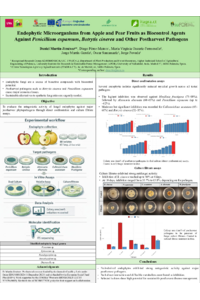
In this study, a broad collection of 88 endophytic isolates (65 fungi/yeasts and 23 bacteria) was obtained from apple, pear and nashi fruits belonging to several commercial varieties. Microorganisms were isolated from both mesocarp and peduncle tissues, with the aim of capturing a representative diversity of fruit-associated endophytes. The antagonistic potential of all isolates was systematically screened through a series of in vitro assays against five major postharvest fungal pathogens of pome fruit: Penicillium expansum, Botrytis cinerea, Alternaria alternata, Colletotrichum acutatum and Monilinia fructigena. Initial confrontation assays revealed that multiple isolates were capable of reproducibly inhibiting pathogen development, as quantified through reductions in colony area relative to untreated controls. These results permitted the selection of a subset of promising strains for further mechanistic studies.
To gain insight into potential modes of action, split-plate assays were performed to evaluate volatile-mediated inhibition. No significant growth suppression was observed, suggesting that volatile organic compounds (VOCs) were not responsible for the antagonistic activity detected in earlier assays. Conversely, liquid-culture filtrates obtained from selected strains revealed that at least one endophyte produced extracellular antifungal metabolites capable of reducing pathogen growth in vitro, supporting the hypothesis that bioactive, secreted compounds contribute to its inhibitory activity. This finding identifies the strain as a particularly strong candidate for future metabolite characterization.
Current and future work is focused on the molecular identification of the most active isolates, extraction and characterization of their inhibitory metabolites, and the assessment of additional mechanisms potentially involved in antagonism, including competition and nutrient depletion. Furthermore, the research pipeline will progress toward in vivo validation on fresh fruit to determine the real-world applicability of the most promising candidates.
Overall, this study highlights the potential of fruit-associated endophytes as a valuable source of sustainable biocontrol agents and antifungal compounds, contributing to the development of climate-adaptive postharvest management strategies and offering new tools for reducing fruit losses in a more environmentally conscious framework.
Keywords
endophytes
biocontrol
postharvest pathogens
antifungal activity
sustainable plant protection
Poster
Póster The 1st International Electronic Conference on Plant Protection - copia.pdf
From waste to protection: evaluating the efficacy of Tenebrio molitor insect frass in the suppression of tomato soil-borne pathogens
Fungal Extracts of Talaromyces ruber: a potential biostimulant on Tomato