Event submissions
Published
This submission belongs to the session 4. Biochemical and Biological Control of the event The 1st International Electronic Conference on Plant Protection
Published date
01 Mar, 2026
Academic Editor
'%3e%3cpath%20d='M12.6657%2010.9104C12.4185%2010.325%2012.0599%209.79327%2011.6097%209.34482C11.1609%208.89508%2010.6293%208.5365%2010.0442%208.28888C10.0389%208.28626%2010.0337%208.28495%2010.0285%208.28233C10.8446%207.69279%2011.3752%206.73249%2011.3752%205.64904C11.3752%203.8542%209.92103%202.39999%208.1262%202.39999C6.33136%202.39999%204.87715%203.8542%204.87715%205.64904C4.87715%206.73249%205.40774%207.69279%206.22393%208.28364C6.21869%208.28626%206.21345%208.28757%206.20821%208.29019C5.62129%208.5378%205.09463%208.89284%204.64265%209.34613C4.1929%209.79493%203.83432%2010.3266%203.58671%2010.9117C3.34345%2011.4845%203.21226%2012.0987%203.20023%2012.7209C3.19988%2012.7349%203.20233%2012.7488%203.20744%2012.7619C3.21255%2012.7749%203.22022%2012.7867%203.22998%2012.7968C3.23975%2012.8068%203.25142%2012.8147%203.26431%2012.8202C3.2772%2012.8256%203.29105%2012.8284%203.30504%2012.8284H4.09109C4.14874%2012.8284%204.19459%2012.7825%204.1959%2012.7262C4.2221%2011.7148%204.62823%2010.7676%205.34617%2010.0497C6.08899%209.30683%207.0755%208.89808%208.1262%208.89808C9.17689%208.89808%2010.1634%209.30683%2010.9062%2010.0497C11.6242%2010.7676%2012.0303%2011.7148%2012.0565%2012.7262C12.0578%2012.7838%2012.1037%2012.8284%2012.1613%2012.8284H12.9474C12.9613%2012.8284%2012.9752%2012.8256%2012.9881%2012.8202C13.001%2012.8147%2013.0126%2012.8068%2013.0224%2012.7968C13.0322%2012.7867%2013.0398%2012.7749%2013.0449%2012.7619C13.0501%2012.7488%2013.0525%2012.7349%2013.0522%2012.7209C13.0391%2012.0947%2012.9094%2011.4855%2012.6657%2010.9104ZM8.1262%207.9024C7.52486%207.9024%206.9589%207.6679%206.53312%207.24211C6.10733%206.81633%205.87283%206.25037%205.87283%205.64904C5.87283%205.0477%206.10733%204.48174%206.53312%204.05596C6.9589%203.63018%207.52486%203.39567%208.1262%203.39567C8.72753%203.39567%209.29349%203.63018%209.71927%204.05596C10.1451%204.48174%2010.3796%205.0477%2010.3796%205.64904C10.3796%206.25037%2010.1451%206.81633%209.71927%207.24211C9.29349%207.6679%208.72753%207.9024%208.1262%207.9024Z'%20fill='%235D1EE1'/%3e%3c/g%3e%3c/svg%3e) Jorge M. S. Faria
Jorge M. S. FariaCitation
El Hadi Erbiai, Fernando Sousa, Teresa Pinto, José Gomes-Laranjo, Guilhermina Marques, Diversity and Biocontrol Efficacy of Entomopathogenic Fungi from Portuguese Chestnut Groves (Soutos) for Integrated and Sustainable Pest Management, in Proceedings of The 1st International Electronic Conference on Plant Protection, 2 March–8 March 2026, MDPI: Basel, Switzerland
Share
Email
Facebook
Twitter
LinkedIn
Diversity and Biocontrol Efficacy of Entomopathogenic Fungi from Portuguese Chestnut Groves (Soutos) for Integrated and Sustainable Pest Management

El Hadi Erbiai 1
'%3e%3cpath%20d='M12.6647%2010.9104C12.4176%2010.325%2012.0589%209.7933%2011.6088%209.34485C11.16%208.89511%2010.6283%208.53653%2010.0432%208.28891C10.038%208.28629%2010.0327%208.28498%2010.0275%208.28236C10.8437%207.69282%2011.3743%206.73252%2011.3743%205.64907C11.3743%203.85423%209.92005%202.40002%208.12522%202.40002C6.33038%202.40002%204.87618%203.85423%204.87618%205.64907C4.87618%206.73252%205.40677%207.69282%206.22296%208.28367C6.21772%208.28629%206.21248%208.2876%206.20724%208.29022C5.62031%208.53783%205.09365%208.89287%204.64167%209.34616C4.19192%209.79496%203.83334%2010.3266%203.58573%2010.9117C3.34247%2011.4846%203.21128%2012.0987%203.19925%2012.721C3.1989%2012.735%203.20135%2012.7489%203.20646%2012.7619C3.21157%2012.7749%203.21924%2012.7868%203.22901%2012.7968C3.23877%2012.8068%203.25045%2012.8148%203.26334%2012.8202C3.27623%2012.8256%203.29007%2012.8284%203.30406%2012.8284H4.09012C4.14776%2012.8284%204.19362%2012.7825%204.19493%2012.7262C4.22113%2011.7148%204.62726%2010.7676%205.34519%2010.0497C6.08802%209.30686%207.07452%208.89811%208.12522%208.89811C9.17592%208.89811%2010.1624%209.30686%2010.9052%2010.0497C11.6232%2010.7676%2012.0293%2011.7148%2012.0555%2012.7262C12.0568%2012.7839%2012.1027%2012.8284%2012.1603%2012.8284H12.9464C12.9604%2012.8284%2012.9742%2012.8256%2012.9871%2012.8202C13%2012.8148%2013.0117%2012.8068%2013.0214%2012.7968C13.0312%2012.7868%2013.0389%2012.7749%2013.044%2012.7619C13.0491%2012.7489%2013.0515%2012.735%2013.0512%2012.721C13.0381%2012.0947%2012.9084%2011.4856%2012.6647%2010.9104ZM8.12522%207.90243C7.52388%207.90243%206.95792%207.66793%206.53214%207.24215C6.10636%206.81636%205.87185%206.2504%205.87185%205.64907C5.87185%205.04773%206.10636%204.48177%206.53214%204.05599C6.95792%203.63021%207.52388%203.3957%208.12522%203.3957C8.72655%203.3957%209.29252%203.63021%209.7183%204.05599C10.1441%204.48177%2010.3786%205.04773%2010.3786%205.64907C10.3786%206.2504%2010.1441%206.81636%209.7183%207.24215C9.29252%207.66793%208.72655%207.90243%208.12522%207.90243Z'%20fill='%235D1EE1'/%3e%3c/g%3e%3c/svg%3e)
Fernando Sousa 2
Teresa Pinto 3
José Gomes-Laranjo 3
Guilhermina Marques 3
1. Centre for the Research and Technology of Agro-Environmental and Biological Sciences (CITAB), University of Trás-os-Montes and Alto Douro (UTAD), Portugal
2. Estudante do Mestrado em Engenharia Agronómica, Universidade de Trás-os-Montes e Alto Douro, 5001-801 Vila Real, Portugal, Portugal
3. Centre for the Research and Technology of Agroenvironmental and Biological Sciences, CITAB, Inov4Agro, Universidadede Trás-os-Montes e Alto Douro, UTAD, Quinta de Prados, 5000-801 Vila Real, Portugal, Portugal
Abstract
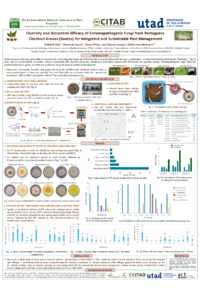
Abstract: The sweet chestnut (Castanea sativa Mill.) is a crop of significant socioeconomic and ecological importance in Portugal. However, its production is heavily affected by several pests, notably chestnut weevils and moths (locally known as bichados), including Cydia fagiglandana, C. splendana, Curculio elephas, and Pammene fasciana. The continuous use of chemical insecticides to control these pests raises environmental and public health concerns, highlighting the urgent need to develop sustainable and eco-friendly alternatives. Entomopathogenic fungi (EPF) represent a promising biological tool capable of selectively reducing pest populations, in line with European Union policies aimed at decreasing agrochemical inputs. Herein, this study aimed to isolate, identify, and assess the diversity of EPF from chestnut grove soils in experimental plots located in Trancoso, as well as to evaluate their field efficacy against chestnut pests compared with the commercial insecticides Affirm Opti® and Spintor 480 SC®. EPF were isolated using the insect-bait method with Tenebrio molitor larvae and identified based on morphological traits and molecular analysis of the ITS and TEF1 regions, followed by phylogenetic analyses. The results revealed a high diversity and abundance of EPF in the chestnut grove soils, with six species isolated. Metarhizium robertsii was the most frequently isolated species, followed by Beauveria bassiana. In field trials, strains of these two predominant species significantly reduced chestnut fruit infestation compared with the chemical treatment. Notably, B. bassiana achieved 100% efficacy against all evaluated pests, followed by M. robertsii, whereas the chemical treatment (Affirm Opti®) exhibited the lowest efficacy. Overall, the native EPF isolates demonstrated strong potential in controlling chestnut pests, particularly B. bassiana, supporting their integration into sustainable and eco-friendly pest management strategies. Further studies are underway to optimize formulation and application methods to facilitate the development of effective commercial bioinsecticides.
Acknowledgments: This work was supported by the project 101074466 — LIFE21-CCA-IT-LIFE FAGESOS and by National Funds through the Fundação para a Ciência e a Tecnologia (FCT) under the scope of the projects UID/04033/2025 (CITAB) (https://doi.org/10.54499/UID/04033/2025) and LA/P/0126/2020 (Inov4Agro) (https://doi.org/10.54499/LA/P/0126/2020). EHE thanks the PRR and the European Funds NextGeneration EU for the research grant BIPD/UTAD/3/2023.
Keywords
Entomopathogenic fungi
bioinsecticides
sustainable pest management
chestnut pests
Beauveria bassiana
Metarhizium robertsii
Poster
IECPP2026_Poster_Erbiai_IDsciforum-164459.pdf
Multi-omics approach applied to the discovery of biopesticides from endophytic fungi
Sustainable management of Root Knot Nematodes in Pomegranate: Impact of Biocontrol Agents on Yield and Grower Profitability