Event submissions
EventsThe 5th International Electronic Conference on Brain Sciences & 1st International Electronic Conference on Neurosciences
Published
This submission belongs to the session S5. Neurorehabilitation of the event The 5th International Electronic Conference on Brain Sciences & 1st International Electronic Conference on Neurosciences
Published date
04 Mar, 2026
Academic Editor
'%3e%3cpath%20d='M12.6657%2010.9104C12.4185%2010.325%2012.0599%209.79327%2011.6097%209.34482C11.1609%208.89508%2010.6293%208.5365%2010.0442%208.28888C10.0389%208.28626%2010.0337%208.28495%2010.0285%208.28233C10.8446%207.69279%2011.3752%206.73249%2011.3752%205.64904C11.3752%203.8542%209.92103%202.39999%208.1262%202.39999C6.33136%202.39999%204.87715%203.8542%204.87715%205.64904C4.87715%206.73249%205.40774%207.69279%206.22393%208.28364C6.21869%208.28626%206.21345%208.28757%206.20821%208.29019C5.62129%208.5378%205.09463%208.89284%204.64265%209.34613C4.1929%209.79493%203.83432%2010.3266%203.58671%2010.9117C3.34345%2011.4845%203.21226%2012.0987%203.20023%2012.7209C3.19988%2012.7349%203.20233%2012.7488%203.20744%2012.7619C3.21255%2012.7749%203.22022%2012.7867%203.22998%2012.7968C3.23975%2012.8068%203.25142%2012.8147%203.26431%2012.8202C3.2772%2012.8256%203.29105%2012.8284%203.30504%2012.8284H4.09109C4.14874%2012.8284%204.19459%2012.7825%204.1959%2012.7262C4.2221%2011.7148%204.62823%2010.7676%205.34617%2010.0497C6.08899%209.30683%207.0755%208.89808%208.1262%208.89808C9.17689%208.89808%2010.1634%209.30683%2010.9062%2010.0497C11.6242%2010.7676%2012.0303%2011.7148%2012.0565%2012.7262C12.0578%2012.7838%2012.1037%2012.8284%2012.1613%2012.8284H12.9474C12.9613%2012.8284%2012.9752%2012.8256%2012.9881%2012.8202C13.001%2012.8147%2013.0126%2012.8068%2013.0224%2012.7968C13.0322%2012.7867%2013.0398%2012.7749%2013.0449%2012.7619C13.0501%2012.7488%2013.0525%2012.7349%2013.0522%2012.7209C13.0391%2012.0947%2012.9094%2011.4855%2012.6657%2010.9104ZM8.1262%207.9024C7.52486%207.9024%206.9589%207.6679%206.53312%207.24211C6.10733%206.81633%205.87283%206.25037%205.87283%205.64904C5.87283%205.0477%206.10733%204.48174%206.53312%204.05596C6.9589%203.63018%207.52486%203.39567%208.1262%203.39567C8.72753%203.39567%209.29349%203.63018%209.71927%204.05596C10.1451%204.48174%2010.3796%205.0477%2010.3796%205.64904C10.3796%206.25037%2010.1451%206.81633%209.71927%207.24211C9.29349%207.6679%208.72753%207.9024%208.1262%207.9024Z'%20fill='%235D1EE1'/%3e%3c/g%3e%3c/svg%3e) Rocco Salvatore Calabrò
Rocco Salvatore CalabròCitation
Victoria Kuvaeva, Anna Beknazarova, Grigorii Iskarevskii, Nikita Nagnibedov, Dmitry Onishchenko, Assessment of knee muscle performance in para-athletes with unilateral transtibial amputation, in Proceedings of The 5th International Electronic Conference on Brain Sciences & 1st International Electronic Conference on Neurosciences, 9 March–11 March 2026, MDPI: Basel, Switzerland
Share
Email
Facebook
Twitter
LinkedIn
Assessment of knee muscle performance in para-athletes with unilateral transtibial amputation
'%3e%3cpath%20d='M12.6647%2010.9104C12.4176%2010.325%2012.0589%209.7933%2011.6088%209.34485C11.16%208.89511%2010.6283%208.53653%2010.0432%208.28891C10.038%208.28629%2010.0327%208.28498%2010.0275%208.28236C10.8437%207.69282%2011.3743%206.73252%2011.3743%205.64907C11.3743%203.85423%209.92005%202.40002%208.12522%202.40002C6.33038%202.40002%204.87618%203.85423%204.87618%205.64907C4.87618%206.73252%205.40677%207.69282%206.22296%208.28367C6.21772%208.28629%206.21248%208.2876%206.20724%208.29022C5.62031%208.53783%205.09365%208.89287%204.64167%209.34616C4.19192%209.79496%203.83334%2010.3266%203.58573%2010.9117C3.34247%2011.4846%203.21128%2012.0987%203.19925%2012.721C3.1989%2012.735%203.20135%2012.7489%203.20646%2012.7619C3.21157%2012.7749%203.21924%2012.7868%203.22901%2012.7968C3.23877%2012.8068%203.25045%2012.8148%203.26334%2012.8202C3.27623%2012.8256%203.29007%2012.8284%203.30406%2012.8284H4.09012C4.14776%2012.8284%204.19362%2012.7825%204.19493%2012.7262C4.22113%2011.7148%204.62726%2010.7676%205.34519%2010.0497C6.08802%209.30686%207.07452%208.89811%208.12522%208.89811C9.17592%208.89811%2010.1624%209.30686%2010.9052%2010.0497C11.6232%2010.7676%2012.0293%2011.7148%2012.0555%2012.7262C12.0568%2012.7839%2012.1027%2012.8284%2012.1603%2012.8284H12.9464C12.9604%2012.8284%2012.9742%2012.8256%2012.9871%2012.8202C13%2012.8148%2013.0117%2012.8068%2013.0214%2012.7968C13.0312%2012.7868%2013.0389%2012.7749%2013.044%2012.7619C13.0491%2012.7489%2013.0515%2012.735%2013.0512%2012.721C13.0381%2012.0947%2012.9084%2011.4856%2012.6647%2010.9104ZM8.12522%207.90243C7.52388%207.90243%206.95792%207.66793%206.53214%207.24215C6.10636%206.81636%205.87185%206.2504%205.87185%205.64907C5.87185%205.04773%206.10636%204.48177%206.53214%204.05599C6.95792%203.63021%207.52388%203.3957%208.12522%203.3957C8.72655%203.3957%209.29252%203.63021%209.7183%204.05599C10.1441%204.48177%2010.3786%205.04773%2010.3786%205.64907C10.3786%206.2504%2010.1441%206.81636%209.7183%207.24215C9.29252%207.66793%208.72655%207.90243%208.12522%207.90243Z'%20fill='%235D1EE1'/%3e%3c/g%3e%3c/svg%3e)
Victoria Kuvaeva 1
Anna Beknazarova 1
Grigorii Iskarevskii 1
Nikita Nagnibedov 2
Dmitry Onishchenko 1
1. Research Center for Genetics and Life Sciences , Sirius University of Science and Technology, Sirius Federal Territory, 354349, Russia
2. Autonomous Non-Commercial Organization “Adaptive Sports Center ‘Orto-Sport’”, Moscow, Russia
Abstract
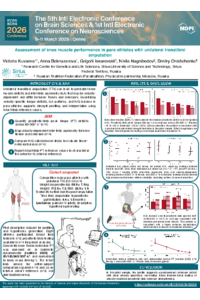
Introduction. Unilateral lower-limb amputation often leads to long-term asymmetry in knee muscle function, which may persist despite rehabilitation. The magnitude and profile of impairment depend on rehabilitation timing and which muscle groups are most affected. Earlier prosthetic rehabilitation is typically associated with better functional preservation, whereas delays can lead to selective deficits – particularly in muscles that contribute to high-velocity movements. Flexors and extensors may recover differently, with consequences for joint stability and movement efficiency. We therefore aimed (I) to determine whether knee flexors or extensors show better functional preservation in unilateral transtibial para-athletes and (II) test whether time-to-prosthetic gait and movement velocity are related to inter-limb asymmetry (ILA).
Methods. Eight male unilateral transtibial para-athletes (classifications C2–C4; height 172.9±7.2 cm; body mass without prosthesis 68.9±7.9 kg; BMI 22.9±1.9) were tested. The mean interval from amputation to first prosthetic gait was 4.4±1.5 months (n=8). Concentric knee flexion/extension was assessed on an Isomed 2000 dynamometer at 60, 180, 240, and 300°·s⁻¹. Four athletes were tested bilaterally and four were tested on the intact limb only (retained to augment intact-limb reference values). Outcomes are listed: peak torque (PT, Nm; Nm·kg⁻¹), hamstrings-to-quadriceps ratio (H/Q, %), and inter-limb asymmetry (ILA, % = |PT_intact−PT_prosthetic|/PT_intact×100). Anthropometrics are reported as mean ± SD; isokinetic outcomes are reported as median [IQR]. The exploratory Spearman method tested the delay–ILA association.
Results. Prosthetic-side torque deficits were evident across all velocities. ILA was velocity-dependent, with minima at 240°·s⁻¹ (flexion) and 300°·s⁻¹ (extension), alongside pronounced individual outliers. H/Q was slightly higher on the prosthetic limb, consistent with relatively preserved flexors.
Conclusion. The profile indicates a selective extensor deficit and clear velocity specificity; prioritize early, targeted, velocity-specific extensor strengthening on the prosthetic side. From the results, earlier initiation of prosthetic gait was associated with lower asymmetry.
Keywords
dynamometry
para-athletes
inter-limb asymmetry
hamstring-to-quadriceps ratio
neurorehabilitation
unilateral amputation
Poster
sciforum-158276 Kuvaeva_Victoria_Assessment of knee muscle performance in para-athletes with unilateral transtibial amputation.pdf
Normative Convolutional Neural Network Modelling of Structural MRI for Personalised Neuroimaging
Protocol for Thalamocortical Functional Connectivity and Loss of Consciousness Investigation in Children with Epilepsy Using Stereo-EEG Data