Event submissions
Published
This submission belongs to the session S2. Optoelectronics & Optical Engineering of the event The 1st International Online Conference on Optics
Published date
20 Mar, 2026
Academic Editor
'%3e%3cpath%20d='M12.6657%2010.9104C12.4185%2010.325%2012.0599%209.79327%2011.6097%209.34482C11.1609%208.89508%2010.6293%208.5365%2010.0442%208.28888C10.0389%208.28626%2010.0337%208.28495%2010.0285%208.28233C10.8446%207.69279%2011.3752%206.73249%2011.3752%205.64904C11.3752%203.8542%209.92103%202.39999%208.1262%202.39999C6.33136%202.39999%204.87715%203.8542%204.87715%205.64904C4.87715%206.73249%205.40774%207.69279%206.22393%208.28364C6.21869%208.28626%206.21345%208.28757%206.20821%208.29019C5.62129%208.5378%205.09463%208.89284%204.64265%209.34613C4.1929%209.79493%203.83432%2010.3266%203.58671%2010.9117C3.34345%2011.4845%203.21226%2012.0987%203.20023%2012.7209C3.19988%2012.7349%203.20233%2012.7488%203.20744%2012.7619C3.21255%2012.7749%203.22022%2012.7867%203.22998%2012.7968C3.23975%2012.8068%203.25142%2012.8147%203.26431%2012.8202C3.2772%2012.8256%203.29105%2012.8284%203.30504%2012.8284H4.09109C4.14874%2012.8284%204.19459%2012.7825%204.1959%2012.7262C4.2221%2011.7148%204.62823%2010.7676%205.34617%2010.0497C6.08899%209.30683%207.0755%208.89808%208.1262%208.89808C9.17689%208.89808%2010.1634%209.30683%2010.9062%2010.0497C11.6242%2010.7676%2012.0303%2011.7148%2012.0565%2012.7262C12.0578%2012.7838%2012.1037%2012.8284%2012.1613%2012.8284H12.9474C12.9613%2012.8284%2012.9752%2012.8256%2012.9881%2012.8202C13.001%2012.8147%2013.0126%2012.8068%2013.0224%2012.7968C13.0322%2012.7867%2013.0398%2012.7749%2013.0449%2012.7619C13.0501%2012.7488%2013.0525%2012.7349%2013.0522%2012.7209C13.0391%2012.0947%2012.9094%2011.4855%2012.6657%2010.9104ZM8.1262%207.9024C7.52486%207.9024%206.9589%207.6679%206.53312%207.24211C6.10733%206.81633%205.87283%206.25037%205.87283%205.64904C5.87283%205.0477%206.10733%204.48174%206.53312%204.05596C6.9589%203.63018%207.52486%203.39567%208.1262%203.39567C8.72753%203.39567%209.29349%203.63018%209.71927%204.05596C10.1451%204.48174%2010.3796%205.0477%2010.3796%205.64904C10.3796%206.25037%2010.1451%206.81633%209.71927%207.24211C9.29349%207.6679%208.72753%207.9024%208.1262%207.9024Z'%20fill='%235D1EE1'/%3e%3c/g%3e%3c/svg%3e) Yuriy Garbovskiy
Yuriy GarbovskiyCitation
Dovydas Blazevicius, Zeyad Taher Abdou, Raminta Beresneviciute, Ernestas Kasparavicius, Julius Petrulevicius, Saulius Grigalevicius, Copolymers with pendent phenoxazine/arylbenzimidazole moieties as bipolar polymeric host materials for green PhOLEDs, in Proceedings of The 1st International Online Conference on Optics, 25 March–27 March 2026, MDPI: Basel, Switzerland
Share
Email
Facebook
Twitter
LinkedIn
Copolymers with pendent phenoxazine/arylbenzimidazole moieties as bipolar polymeric host materials for green PhOLEDs
'%3e%3cpath%20d='M12.6647%2010.9104C12.4176%2010.325%2012.0589%209.7933%2011.6088%209.34485C11.16%208.89511%2010.6283%208.53653%2010.0432%208.28891C10.038%208.28629%2010.0327%208.28498%2010.0275%208.28236C10.8437%207.69282%2011.3743%206.73252%2011.3743%205.64907C11.3743%203.85423%209.92005%202.40002%208.12522%202.40002C6.33038%202.40002%204.87618%203.85423%204.87618%205.64907C4.87618%206.73252%205.40677%207.69282%206.22296%208.28367C6.21772%208.28629%206.21248%208.2876%206.20724%208.29022C5.62031%208.53783%205.09365%208.89287%204.64167%209.34616C4.19192%209.79496%203.83334%2010.3266%203.58573%2010.9117C3.34247%2011.4846%203.21128%2012.0987%203.19925%2012.721C3.1989%2012.735%203.20135%2012.7489%203.20646%2012.7619C3.21157%2012.7749%203.21924%2012.7868%203.22901%2012.7968C3.23877%2012.8068%203.25045%2012.8148%203.26334%2012.8202C3.27623%2012.8256%203.29007%2012.8284%203.30406%2012.8284H4.09012C4.14776%2012.8284%204.19362%2012.7825%204.19493%2012.7262C4.22113%2011.7148%204.62726%2010.7676%205.34519%2010.0497C6.08802%209.30686%207.07452%208.89811%208.12522%208.89811C9.17592%208.89811%2010.1624%209.30686%2010.9052%2010.0497C11.6232%2010.7676%2012.0293%2011.7148%2012.0555%2012.7262C12.0568%2012.7839%2012.1027%2012.8284%2012.1603%2012.8284H12.9464C12.9604%2012.8284%2012.9742%2012.8256%2012.9871%2012.8202C13%2012.8148%2013.0117%2012.8068%2013.0214%2012.7968C13.0312%2012.7868%2013.0389%2012.7749%2013.044%2012.7619C13.0491%2012.7489%2013.0515%2012.735%2013.0512%2012.721C13.0381%2012.0947%2012.9084%2011.4856%2012.6647%2010.9104ZM8.12522%207.90243C7.52388%207.90243%206.95792%207.66793%206.53214%207.24215C6.10636%206.81636%205.87185%206.2504%205.87185%205.64907C5.87185%205.04773%206.10636%204.48177%206.53214%204.05599C6.95792%203.63021%207.52388%203.3957%208.12522%203.3957C8.72655%203.3957%209.29252%203.63021%209.7183%204.05599C10.1441%204.48177%2010.3786%205.04773%2010.3786%205.64907C10.3786%206.2504%2010.1441%206.81636%209.7183%207.24215C9.29252%207.66793%208.72655%207.90243%208.12522%207.90243Z'%20fill='%235D1EE1'/%3e%3c/g%3e%3c/svg%3e)
Zeyad Taher Abdou 1
Dovydas Blazevicius 2
Raminta Beresneviciute 2
Ernestas Kasparavicius 3
Julius Petrulevicius 3

Saulius Grigalevicius 2
1. Department of Polymer Chemistry and Technology, Kaunas University of Technology, Radvilenu Plentas 19, LT50254 Kaunas, Lithuania, Turkey (Türkiye)
2. Department of Polymer Chemistry and Technology, Kaunas University of Technology, Radvilenu Plentas 19, LT50254 Kaunas, Lithuania, Lithuania
3. Department of Organic Chemistry, Kaunas University of Technology, Kaunas, Lithuania, Lithuania
Abstract
A group of vinyl copolymers containing electronically isolated phenoxazine as an electron-donating unit and either 2-phenylbenzimidazole or 2-(2-pyridyl)benzimidazole as electron-accepting units was synthesized via a multistep synthetic route. The corresponding vinyl monomers were polymerized by cationic polymerization in solution to obtain amorphous bipolar polymeric materials. The chemical structures and molecular characteristics of the synthesized copolymers were fully characterized by NMR spectroscopy, elemental analysis, and gel permeation chromatography. Thermal and morphological properties were investigated using thermogravimetric analysis and differential scanning calorimetry. All materials exhibited high thermal stability, with initial thermal degradation temperatures in the range of 300–320 °C. Furthermore, the polymers demonstrated very high glass transition temperatures between 151 and 160 °C, indicating the excellent morphological stability of amorphous films, with only a minor dependence on the nature of the aromatic acceptor chromophore. The synthesized copolymers were evaluated as host materials in phosphorescent organic light-emitting diodes (PhOLEDs), using bis(2-phenylpyridine)(acetylacetonato)iridium(III), [Ir(ppy)₂(acac)] as the emissive dopant. Devices based on the copolymer PPxPy1, incorporating phenoxazine and 2-(2-pyridyl)benzimidazole units, exhibited promising electroluminescent performance, characterized by a low turn-on voltage of 3.0 V, a maximum luminance exceeding 2000 cd/m², and a maximum current efficiency of approximately 13.4 cd/A. A similar device employing the copolymer PPxP3, containing phenoxazine and 2-phenylbenzimidazole chromophores, showed the best overall performance, achieving a low turn-on voltage of 3.0 V, a maximum brightness above 2800 cd/m², and a maximum current efficiency of about 13.0 cd/A. These results demonstrate the potential of phenoxazine–benzimidazole-based vinyl copolymers as thermally robust and efficient host materials for phosphorescent OLED applications.
Keywords
OLED
Organic semiconductor
Host material
Organic Synthesis
Poster
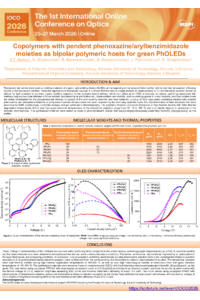
ZT Poster.pdf
Optical ultrasonic imaging of geological structure models
3-Ethylcarbazole as a building block for new OLED host materials achieving EQEs over 20%