Event submissions
Published
This submission belongs to the session S2. Optoelectronics & Optical Engineering of the event The 1st International Online Conference on Optics
Published date
20 Mar, 2026
Academic Editor
'%3e%3cpath%20d='M12.6657%2010.9104C12.4185%2010.325%2012.0599%209.79327%2011.6097%209.34482C11.1609%208.89508%2010.6293%208.5365%2010.0442%208.28888C10.0389%208.28626%2010.0337%208.28495%2010.0285%208.28233C10.8446%207.69279%2011.3752%206.73249%2011.3752%205.64904C11.3752%203.8542%209.92103%202.39999%208.1262%202.39999C6.33136%202.39999%204.87715%203.8542%204.87715%205.64904C4.87715%206.73249%205.40774%207.69279%206.22393%208.28364C6.21869%208.28626%206.21345%208.28757%206.20821%208.29019C5.62129%208.5378%205.09463%208.89284%204.64265%209.34613C4.1929%209.79493%203.83432%2010.3266%203.58671%2010.9117C3.34345%2011.4845%203.21226%2012.0987%203.20023%2012.7209C3.19988%2012.7349%203.20233%2012.7488%203.20744%2012.7619C3.21255%2012.7749%203.22022%2012.7867%203.22998%2012.7968C3.23975%2012.8068%203.25142%2012.8147%203.26431%2012.8202C3.2772%2012.8256%203.29105%2012.8284%203.30504%2012.8284H4.09109C4.14874%2012.8284%204.19459%2012.7825%204.1959%2012.7262C4.2221%2011.7148%204.62823%2010.7676%205.34617%2010.0497C6.08899%209.30683%207.0755%208.89808%208.1262%208.89808C9.17689%208.89808%2010.1634%209.30683%2010.9062%2010.0497C11.6242%2010.7676%2012.0303%2011.7148%2012.0565%2012.7262C12.0578%2012.7838%2012.1037%2012.8284%2012.1613%2012.8284H12.9474C12.9613%2012.8284%2012.9752%2012.8256%2012.9881%2012.8202C13.001%2012.8147%2013.0126%2012.8068%2013.0224%2012.7968C13.0322%2012.7867%2013.0398%2012.7749%2013.0449%2012.7619C13.0501%2012.7488%2013.0525%2012.7349%2013.0522%2012.7209C13.0391%2012.0947%2012.9094%2011.4855%2012.6657%2010.9104ZM8.1262%207.9024C7.52486%207.9024%206.9589%207.6679%206.53312%207.24211C6.10733%206.81633%205.87283%206.25037%205.87283%205.64904C5.87283%205.0477%206.10733%204.48174%206.53312%204.05596C6.9589%203.63018%207.52486%203.39567%208.1262%203.39567C8.72753%203.39567%209.29349%203.63018%209.71927%204.05596C10.1451%204.48174%2010.3796%205.0477%2010.3796%205.64904C10.3796%206.25037%2010.1451%206.81633%209.71927%207.24211C9.29349%207.6679%208.72753%207.9024%208.1262%207.9024Z'%20fill='%235D1EE1'/%3e%3c/g%3e%3c/svg%3e) Yuriy Garbovskiy
Yuriy GarbovskiyCitation
Dovydas Blazevicius, Raminta Beresneviciute, Ernestas Kasparavicius, Julius Petrulevicius, Saulius Grigalevicius, Chih-Hung Ko, Cai-Fan Lo, Chih-Hao Chang, 3-Ethylcarbazole as a building block for new OLED host materials achieving EQEs over 20%, in Proceedings of The 1st International Online Conference on Optics, 25 March–27 March 2026, MDPI: Basel, Switzerland
Share
Email
Facebook
Twitter
LinkedIn
3-Ethylcarbazole as a building block for new OLED host materials achieving EQEs over 20%
'%3e%3cpath%20d='M12.6647%2010.9104C12.4176%2010.325%2012.0589%209.7933%2011.6088%209.34485C11.16%208.89511%2010.6283%208.53653%2010.0432%208.28891C10.038%208.28629%2010.0327%208.28498%2010.0275%208.28236C10.8437%207.69282%2011.3743%206.73252%2011.3743%205.64907C11.3743%203.85423%209.92005%202.40002%208.12522%202.40002C6.33038%202.40002%204.87618%203.85423%204.87618%205.64907C4.87618%206.73252%205.40677%207.69282%206.22296%208.28367C6.21772%208.28629%206.21248%208.2876%206.20724%208.29022C5.62031%208.53783%205.09365%208.89287%204.64167%209.34616C4.19192%209.79496%203.83334%2010.3266%203.58573%2010.9117C3.34247%2011.4846%203.21128%2012.0987%203.19925%2012.721C3.1989%2012.735%203.20135%2012.7489%203.20646%2012.7619C3.21157%2012.7749%203.21924%2012.7868%203.22901%2012.7968C3.23877%2012.8068%203.25045%2012.8148%203.26334%2012.8202C3.27623%2012.8256%203.29007%2012.8284%203.30406%2012.8284H4.09012C4.14776%2012.8284%204.19362%2012.7825%204.19493%2012.7262C4.22113%2011.7148%204.62726%2010.7676%205.34519%2010.0497C6.08802%209.30686%207.07452%208.89811%208.12522%208.89811C9.17592%208.89811%2010.1624%209.30686%2010.9052%2010.0497C11.6232%2010.7676%2012.0293%2011.7148%2012.0555%2012.7262C12.0568%2012.7839%2012.1027%2012.8284%2012.1603%2012.8284H12.9464C12.9604%2012.8284%2012.9742%2012.8256%2012.9871%2012.8202C13%2012.8148%2013.0117%2012.8068%2013.0214%2012.7968C13.0312%2012.7868%2013.0389%2012.7749%2013.044%2012.7619C13.0491%2012.7489%2013.0515%2012.735%2013.0512%2012.721C13.0381%2012.0947%2012.9084%2011.4856%2012.6647%2010.9104ZM8.12522%207.90243C7.52388%207.90243%206.95792%207.66793%206.53214%207.24215C6.10636%206.81636%205.87185%206.2504%205.87185%205.64907C5.87185%205.04773%206.10636%204.48177%206.53214%204.05599C6.95792%203.63021%207.52388%203.3957%208.12522%203.3957C8.72655%203.3957%209.29252%203.63021%209.7183%204.05599C10.1441%204.48177%2010.3786%205.04773%2010.3786%205.64907C10.3786%206.2504%2010.1441%206.81636%209.7183%207.24215C9.29252%207.66793%208.72655%207.90243%208.12522%207.90243Z'%20fill='%235D1EE1'/%3e%3c/g%3e%3c/svg%3e)
Dovydas Blazevicius 1
Raminta Beresneviciute 1
Ernestas Kasparavicius 2
Julius Petrulevicius 2

Saulius Grigalevicius 1
Chih-Hung Ko 3
Cai-Fan Lo 3

Chih-Hao Chang 3
1. Department of Polymer Chemistry and Technology, Kaunas University of Technology, Radvilenu Plentas 19, LT50254 Kaunas, Lithuania, Lithuania
2. Department of Organic Chemistry, Kaunas University of Technology, Kaunas, Lithuania, Lithuania
3. Department of Electrical Engineering, Yuan Ze University, Taoyuan 32003, Taiwan, Taiwan
Abstract
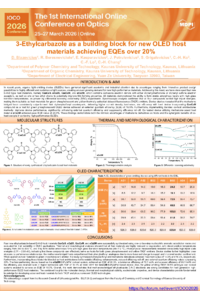
Organic light-emitting diodes (OLEDs) have garnered significant attention due to advantages ranging from innovative product design possibilities to highly efficient and sustainable light sources, creating a demand for new high-performance materials. Addressing this need, new ethylcarbazole-based D-A-D host materials were synthesized using one- or two-step nucleophilic aromatic substitution routes and evaluated for their suitability in OLEDs. Materials had one (CzeCzS, CzeCzM) or two (eCz2S, eCz2M) ethylcarbazole units paired with either sulfonyl (CzeCzS, eCz2S) or methanone (CzeCzM, eCz2M) electron acceptors. Thermal and morphological analyses showed that all materials are highly resistant to degradation, with decomposition temperatures ranging from 393 to 436 °C, and they form stable amorphous films with high Tg values (89–112 °C). Photophysical measurements revealed high triplet state energies (2.71 – 2.90 eV), indicating that these compounds can serve as hosts for both green phosphorescent and yellow TADF emitters. Device studies highlighted that methanone-bridged hosts outperformed phenylsulfonyl analogues due to more balanced charge transport and improved exciton confinement. When applied as host materials to a green phosphorescent emitter, a maximum EQE of 16.5% was achieved. Incorporating these hosts into blended co-host architectures led to notable efficiency enhancements, with external quantum efficiency values surpassing 20%. The best-performing device, based on the eCz2M/B3PyMPM co-host system, achieved an EQE of 20.3%, a luminance efficiency of 72.7 cd/A, and a power efficiency of 95.1 lm/W. Also, for a yellow-emitting TADF OLED prototype, our co-host systems enabled the achievement of an EQE of 10.3%. This work demonstrates that methanone–ethylcarbazole D-A-D structures are strong candidates for next-generation efficient OLED host materials. This work provides fundamental knowledge for developing advanced host materials for both TADF and phosphorescent OLED technologies.
Acknowledgements.
We acknowledge support from the Research Council of Lithuania (grant No. -SLLT-25-2) and support from the Faculty of Chemistry and Chemical Technology of Kaunas University of Technology.
Keywords
OLED
Organic semiconductor
Host material
Organic Synthesis
Poster
D.Blazevicius poster.pdf
Copolymers with pendent phenoxazine/arylbenzimidazole moieties as bipolar polymeric host materials for green PhOLEDs
Super-resolution imaging enabled by nonlinear optical response of upconversion nanoparticles