Event submissions
Published
This submission belongs to the session S3. Ethnopharmacology in Antimicrobial Research and Treatment of the event Antibiotics 2026—Advances in Antimicrobial Action and Resistance
Published date
04 May, 2026
Academic Editor
'%3e%3cpath%20d='M12.6657%2010.9104C12.4185%2010.325%2012.0599%209.79327%2011.6097%209.34482C11.1609%208.89508%2010.6293%208.5365%2010.0442%208.28888C10.0389%208.28626%2010.0337%208.28495%2010.0285%208.28233C10.8446%207.69279%2011.3752%206.73249%2011.3752%205.64904C11.3752%203.8542%209.92103%202.39999%208.1262%202.39999C6.33136%202.39999%204.87715%203.8542%204.87715%205.64904C4.87715%206.73249%205.40774%207.69279%206.22393%208.28364C6.21869%208.28626%206.21345%208.28757%206.20821%208.29019C5.62129%208.5378%205.09463%208.89284%204.64265%209.34613C4.1929%209.79493%203.83432%2010.3266%203.58671%2010.9117C3.34345%2011.4845%203.21226%2012.0987%203.20023%2012.7209C3.19988%2012.7349%203.20233%2012.7488%203.20744%2012.7619C3.21255%2012.7749%203.22022%2012.7867%203.22998%2012.7968C3.23975%2012.8068%203.25142%2012.8147%203.26431%2012.8202C3.2772%2012.8256%203.29105%2012.8284%203.30504%2012.8284H4.09109C4.14874%2012.8284%204.19459%2012.7825%204.1959%2012.7262C4.2221%2011.7148%204.62823%2010.7676%205.34617%2010.0497C6.08899%209.30683%207.0755%208.89808%208.1262%208.89808C9.17689%208.89808%2010.1634%209.30683%2010.9062%2010.0497C11.6242%2010.7676%2012.0303%2011.7148%2012.0565%2012.7262C12.0578%2012.7838%2012.1037%2012.8284%2012.1613%2012.8284H12.9474C12.9613%2012.8284%2012.9752%2012.8256%2012.9881%2012.8202C13.001%2012.8147%2013.0126%2012.8068%2013.0224%2012.7968C13.0322%2012.7867%2013.0398%2012.7749%2013.0449%2012.7619C13.0501%2012.7488%2013.0525%2012.7349%2013.0522%2012.7209C13.0391%2012.0947%2012.9094%2011.4855%2012.6657%2010.9104ZM8.1262%207.9024C7.52486%207.9024%206.9589%207.6679%206.53312%207.24211C6.10733%206.81633%205.87283%206.25037%205.87283%205.64904C5.87283%205.0477%206.10733%204.48174%206.53312%204.05596C6.9589%203.63018%207.52486%203.39567%208.1262%203.39567C8.72753%203.39567%209.29349%203.63018%209.71927%204.05596C10.1451%204.48174%2010.3796%205.0477%2010.3796%205.64904C10.3796%206.25037%2010.1451%206.81633%209.71927%207.24211C9.29349%207.6679%208.72753%207.9024%208.1262%207.9024Z'%20fill='%235D1EE1'/%3e%3c/g%3e%3c/svg%3e) Manuel Simões
Manuel SimõesCitation
Nora Mestorino, Federico Toso, Daniel Buldain, María Laura Marchetti, Oregano–Rosemary Essential Oil Combinations as Potential Growth-Promoting Alternatives in Poultry: Evidence from Bacterial Time–Kill Curves, in Proceedings of Antibiotics 2026—Advances in Antimicrobial Action and Resistance, Barcelona, 11 May–14 May 2026, MDPI: Basel, Switzerland
Share
Email
Facebook
Twitter
LinkedIn
Oregano–Rosemary Essential Oil Combinations as Potential Growth-Promoting Alternatives in Poultry: Evidence from Bacterial Time–Kill Curves
'%3e%3cpath%20d='M12.6647%2010.9104C12.4176%2010.325%2012.0589%209.7933%2011.6088%209.34485C11.16%208.89511%2010.6283%208.53653%2010.0432%208.28891C10.038%208.28629%2010.0327%208.28498%2010.0275%208.28236C10.8437%207.69282%2011.3743%206.73252%2011.3743%205.64907C11.3743%203.85423%209.92005%202.40002%208.12522%202.40002C6.33038%202.40002%204.87618%203.85423%204.87618%205.64907C4.87618%206.73252%205.40677%207.69282%206.22296%208.28367C6.21772%208.28629%206.21248%208.2876%206.20724%208.29022C5.62031%208.53783%205.09365%208.89287%204.64167%209.34616C4.19192%209.79496%203.83334%2010.3266%203.58573%2010.9117C3.34247%2011.4846%203.21128%2012.0987%203.19925%2012.721C3.1989%2012.735%203.20135%2012.7489%203.20646%2012.7619C3.21157%2012.7749%203.21924%2012.7868%203.22901%2012.7968C3.23877%2012.8068%203.25045%2012.8148%203.26334%2012.8202C3.27623%2012.8256%203.29007%2012.8284%203.30406%2012.8284H4.09012C4.14776%2012.8284%204.19362%2012.7825%204.19493%2012.7262C4.22113%2011.7148%204.62726%2010.7676%205.34519%2010.0497C6.08802%209.30686%207.07452%208.89811%208.12522%208.89811C9.17592%208.89811%2010.1624%209.30686%2010.9052%2010.0497C11.6232%2010.7676%2012.0293%2011.7148%2012.0555%2012.7262C12.0568%2012.7839%2012.1027%2012.8284%2012.1603%2012.8284H12.9464C12.9604%2012.8284%2012.9742%2012.8256%2012.9871%2012.8202C13%2012.8148%2013.0117%2012.8068%2013.0214%2012.7968C13.0312%2012.7868%2013.0389%2012.7749%2013.044%2012.7619C13.0491%2012.7489%2013.0515%2012.735%2013.0512%2012.721C13.0381%2012.0947%2012.9084%2011.4856%2012.6647%2010.9104ZM8.12522%207.90243C7.52388%207.90243%206.95792%207.66793%206.53214%207.24215C6.10636%206.81636%205.87185%206.2504%205.87185%205.64907C5.87185%205.04773%206.10636%204.48177%206.53214%204.05599C6.95792%203.63021%207.52388%203.3957%208.12522%203.3957C8.72655%203.3957%209.29252%203.63021%209.7183%204.05599C10.1441%204.48177%2010.3786%205.04773%2010.3786%205.64907C10.3786%206.2504%2010.1441%206.81636%209.7183%207.24215C9.29252%207.66793%208.72655%207.90243%208.12522%207.90243Z'%20fill='%235D1EE1'/%3e%3c/g%3e%3c/svg%3e)
Federico Toso 1,2
Daniel Buldain 1,3

María Laura Marchetti 1

Nora Mestorino 1,4
1. Laboratorio de Estudios Farmacológicos y Toxicológicos -LEFyT-, Facultad de Ciencias Veterinarias, Universidad Nacional de La Plata. La Plata, 1900, Buenos Aires, Argentina., Argentina
2. Centro de investigación y desarrollo de fármacos -CIDEF-, Facultad de Ciencias Veterinarias, Universidad Nacional de La Pampa. General Pico, 6360, La Pampa, Argentina
3. Consejo Nacional de Investigaciones Científicas y Técnicas (CONICET), Godoy Cruz 2290, CABA, Argentina
4. Farmacología y Toxicología, Facultad de Ciencias Veterinarias, Universidad Católica de Cuyo, San Luis, 5700, Argentina
Abstract
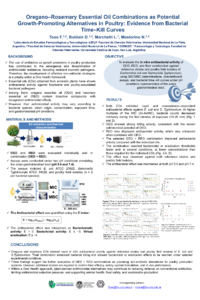
The widespread use of antibiotics as growth promoters in poultry production has contributed to the emergence of antimicrobial resistance and the dissemination of zoonotic pathogens, underscoring the urgent need for effective non-antibiotic alternatives. This study aimed to evaluate the in vitro antibacterial activity of oregano (Origanum vulgare) essential oil (OEO), rosemary (Salvia Rosmarinus) essential oil (REO), and their combination (OR) against Escherichia coli and Salmonella typhimurium strains of poultry origin.
Minimum inhibitory and bactericidal concentrations were determined, and the optimal OR combination was selected using checkerboard assays. Time–kill curves were performed using ATCC reference strains (E. coli ATCC 25922 and S. Typhimurium ATCC 14028), as well as poultry field isolates (n = 2 per species), exposed to individual essential oils and their combination at different multiples of the MIC, under pH conditions simulating the avian gastrointestinal tract (pH 5.0 and 7.4). Bacterial viability was monitored over time based on viable cell counts (CFU/mL), and antibacterial activity was quantified using the antibacterial effect index (E). Results were interpreted according to established cut-off values for bacteriostatic activity (E = 0), bactericidal activity (E ≤ −3), and virtual eradication (E ≤ −4).
Both essential oils exhibited rapid and concentration-dependent antibacterial activity. At 2× and 4× MIC, OEO and REO induced immediate bacterial killing, achieving virtual eradication (E ≤ −4) within 10–20 minutes of exposure. The OR combination consistently enhanced antibacterial activity, reaching bactericidal and eradication thresholds faster and at lower concentrations compared to individual oils. Comparable killing dynamics were observed across pH conditions and between reference strains and poultry field isolates for both E. coli and S. typhimurium.
These findings demonstrate the potent and rapid antimicrobial action of OEO and REO, particularly when used in combination, supporting their potential application as non-antibiotic growth-promoting alternatives in poultry production within a One Health framework.
Keywords
Essential oils
Oregano and rosemary
Time–kill curves
Non-antibiotic growth promoters
Poultry production
Antimicrobial resistance
Poster
TOSO Antibiotics 2026.pdf
Potential use of honey as an antibiotic for Staphylococcus aureus: An AFM study
Underrepresented Sequence–Derived Peptides as a Novel Antimicrobial Platform to Mitigate Resistance Development