Event submissions
Published
This submission belongs to the session S4. Conventional and Novel Approaches in the Discovery of New Antimicrobial Agents of the event Antibiotics 2026—Advances in Antimicrobial Action and Resistance
Published date
04 May, 2026
Academic Editor
'%3e%3cpath%20d='M12.6657%2010.9104C12.4185%2010.325%2012.0599%209.79327%2011.6097%209.34482C11.1609%208.89508%2010.6293%208.5365%2010.0442%208.28888C10.0389%208.28626%2010.0337%208.28495%2010.0285%208.28233C10.8446%207.69279%2011.3752%206.73249%2011.3752%205.64904C11.3752%203.8542%209.92103%202.39999%208.1262%202.39999C6.33136%202.39999%204.87715%203.8542%204.87715%205.64904C4.87715%206.73249%205.40774%207.69279%206.22393%208.28364C6.21869%208.28626%206.21345%208.28757%206.20821%208.29019C5.62129%208.5378%205.09463%208.89284%204.64265%209.34613C4.1929%209.79493%203.83432%2010.3266%203.58671%2010.9117C3.34345%2011.4845%203.21226%2012.0987%203.20023%2012.7209C3.19988%2012.7349%203.20233%2012.7488%203.20744%2012.7619C3.21255%2012.7749%203.22022%2012.7867%203.22998%2012.7968C3.23975%2012.8068%203.25142%2012.8147%203.26431%2012.8202C3.2772%2012.8256%203.29105%2012.8284%203.30504%2012.8284H4.09109C4.14874%2012.8284%204.19459%2012.7825%204.1959%2012.7262C4.2221%2011.7148%204.62823%2010.7676%205.34617%2010.0497C6.08899%209.30683%207.0755%208.89808%208.1262%208.89808C9.17689%208.89808%2010.1634%209.30683%2010.9062%2010.0497C11.6242%2010.7676%2012.0303%2011.7148%2012.0565%2012.7262C12.0578%2012.7838%2012.1037%2012.8284%2012.1613%2012.8284H12.9474C12.9613%2012.8284%2012.9752%2012.8256%2012.9881%2012.8202C13.001%2012.8147%2013.0126%2012.8068%2013.0224%2012.7968C13.0322%2012.7867%2013.0398%2012.7749%2013.0449%2012.7619C13.0501%2012.7488%2013.0525%2012.7349%2013.0522%2012.7209C13.0391%2012.0947%2012.9094%2011.4855%2012.6657%2010.9104ZM8.1262%207.9024C7.52486%207.9024%206.9589%207.6679%206.53312%207.24211C6.10733%206.81633%205.87283%206.25037%205.87283%205.64904C5.87283%205.0477%206.10733%204.48174%206.53312%204.05596C6.9589%203.63018%207.52486%203.39567%208.1262%203.39567C8.72753%203.39567%209.29349%203.63018%209.71927%204.05596C10.1451%204.48174%2010.3796%205.0477%2010.3796%205.64904C10.3796%206.25037%2010.1451%206.81633%209.71927%207.24211C9.29349%207.6679%208.72753%207.9024%208.1262%207.9024Z'%20fill='%235D1EE1'/%3e%3c/g%3e%3c/svg%3e) Marc Maresca
Marc MarescaCitation
Raneen Hijaze, Tareq Tarabeh, Noam Adir, Nofar Yehuda, Guy Lutzky, Sima Yaron, Underrepresented Sequence–Derived Peptides as a Novel Antimicrobial Platform to Mitigate Resistance Development, in Proceedings of Antibiotics 2026—Advances in Antimicrobial Action and Resistance, Barcelona, 11 May–14 May 2026, MDPI: Basel, Switzerland
Share
Email
Facebook
Twitter
LinkedIn
Underrepresented Sequence–Derived Peptides as a Novel Antimicrobial Platform to Mitigate Resistance Development
'%3e%3cpath%20d='M12.6647%2010.9104C12.4176%2010.325%2012.0589%209.7933%2011.6088%209.34485C11.16%208.89511%2010.6283%208.53653%2010.0432%208.28891C10.038%208.28629%2010.0327%208.28498%2010.0275%208.28236C10.8437%207.69282%2011.3743%206.73252%2011.3743%205.64907C11.3743%203.85423%209.92005%202.40002%208.12522%202.40002C6.33038%202.40002%204.87618%203.85423%204.87618%205.64907C4.87618%206.73252%205.40677%207.69282%206.22296%208.28367C6.21772%208.28629%206.21248%208.2876%206.20724%208.29022C5.62031%208.53783%205.09365%208.89287%204.64167%209.34616C4.19192%209.79496%203.83334%2010.3266%203.58573%2010.9117C3.34247%2011.4846%203.21128%2012.0987%203.19925%2012.721C3.1989%2012.735%203.20135%2012.7489%203.20646%2012.7619C3.21157%2012.7749%203.21924%2012.7868%203.22901%2012.7968C3.23877%2012.8068%203.25045%2012.8148%203.26334%2012.8202C3.27623%2012.8256%203.29007%2012.8284%203.30406%2012.8284H4.09012C4.14776%2012.8284%204.19362%2012.7825%204.19493%2012.7262C4.22113%2011.7148%204.62726%2010.7676%205.34519%2010.0497C6.08802%209.30686%207.07452%208.89811%208.12522%208.89811C9.17592%208.89811%2010.1624%209.30686%2010.9052%2010.0497C11.6232%2010.7676%2012.0293%2011.7148%2012.0555%2012.7262C12.0568%2012.7839%2012.1027%2012.8284%2012.1603%2012.8284H12.9464C12.9604%2012.8284%2012.9742%2012.8256%2012.9871%2012.8202C13%2012.8148%2013.0117%2012.8068%2013.0214%2012.7968C13.0312%2012.7868%2013.0389%2012.7749%2013.044%2012.7619C13.0491%2012.7489%2013.0515%2012.735%2013.0512%2012.721C13.0381%2012.0947%2012.9084%2011.4856%2012.6647%2010.9104ZM8.12522%207.90243C7.52388%207.90243%206.95792%207.66793%206.53214%207.24215C6.10636%206.81636%205.87185%206.2504%205.87185%205.64907C5.87185%205.04773%206.10636%204.48177%206.53214%204.05599C6.95792%203.63021%207.52388%203.3957%208.12522%203.3957C8.72655%203.3957%209.29252%203.63021%209.7183%204.05599C10.1441%204.48177%2010.3786%205.04773%2010.3786%205.64907C10.3786%206.2504%2010.1441%206.81636%209.7183%207.24215C9.29252%207.66793%208.72655%207.90243%208.12522%207.90243Z'%20fill='%235D1EE1'/%3e%3c/g%3e%3c/svg%3e)
Raneen Hijaze 1
Tareq Tarabeh 1
Noam Adir 1
Nofar Yehuda 1
Guy Lutzky 1
Sima Yaron 1
1. Technion, Israel, Israel
Abstract
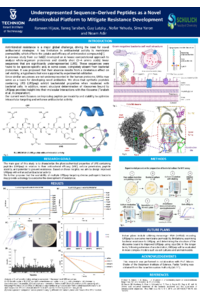
Antimicrobial resistance poses a growing global challenge, necessitating the development of novel antibacterial strategies. One promising approach is based on short amino acid motifs that are significantly underrepresented or absent in bacterial proteomes (URS).
Using a computational strategy developed in our laboratory, Navon et al. (PNAS 2016) identified URSs by detecting patterns missing from proteomic datasets. These sequences are often species-specific and, in some cases, completely absent from bacterial proteomes. Introduction of a URSs can lead to translational arrest and even cell death. These sequences are not URSs in the human proteome, suggesting potential use as antibiotics.
Two URSs shown to induce translational inhibition in E. coli are CMY and CMYW. Based on these findings, we proposed two implementation strategies: delivery of synthetic URS-containing peptides or expression of URS-encoding sequences.
Chemically synthesized peptides, including CMY- and CMYW-based sequences, were applied to Escherichia coli and Salmonella cultures. These peptides exhibited limited antibacterial activity, likely due to restricted membrane permeability associated with their hydrophobic nature. To overcome this limitation, the peptides were conjugated to cell-penetrating peptides (CPPs), resulting in a substantial improvement in antibacterial activity. Optimized peptides, including RLLRRCMYW, exhibited MIC values in the range of 8–16 µM, comparable to those of conventional antibiotics, due to improved cellular uptake and stability. Notably, CMYW-based peptides showed enhanced activity relative to CMY, consistent with stronger ribosomal stalling and their absence from bacterial proteomes.
In addition, heterologous expression of URS-encoding sequences inhibited bacterial growth, supporting that URS motifs impair growth through disruption of translation.
Structural determination of ribosome–URSpep complexes (Tarabeh et al., in preparation) provides insight into their molecular interactions with the ribosome.
Our current work focuses on further optimizing peptide permeability and stability to enhance intracellular targeting of the ribosome and maximize antibacterial activity.
Keywords
Underrepresented sequences
antimicrobial peptides
novel antimicrobial platform
peptide discovery
bacterial resistance
rational design
Poster
Conference Poster_raneen.pdf
Oregano–Rosemary Essential Oil Combinations as Potential Growth-Promoting Alternatives in Poultry: Evidence from Bacterial Time–Kill Curves
Isolation and characterization of bacteriophages active against Pseudomonas aeruginosa strains isolated from ocular infection