Event submissions
Published
This submission belongs to the session S2. Urban Environments and Sustainability of the event The 1st International Online Conference on Urban Sciences
Published date
15 May, 2026
Academic Editor
'%3e%3cpath%20d='M12.6657%2010.9104C12.4185%2010.325%2012.0599%209.79327%2011.6097%209.34482C11.1609%208.89508%2010.6293%208.5365%2010.0442%208.28888C10.0389%208.28626%2010.0337%208.28495%2010.0285%208.28233C10.8446%207.69279%2011.3752%206.73249%2011.3752%205.64904C11.3752%203.8542%209.92103%202.39999%208.1262%202.39999C6.33136%202.39999%204.87715%203.8542%204.87715%205.64904C4.87715%206.73249%205.40774%207.69279%206.22393%208.28364C6.21869%208.28626%206.21345%208.28757%206.20821%208.29019C5.62129%208.5378%205.09463%208.89284%204.64265%209.34613C4.1929%209.79493%203.83432%2010.3266%203.58671%2010.9117C3.34345%2011.4845%203.21226%2012.0987%203.20023%2012.7209C3.19988%2012.7349%203.20233%2012.7488%203.20744%2012.7619C3.21255%2012.7749%203.22022%2012.7867%203.22998%2012.7968C3.23975%2012.8068%203.25142%2012.8147%203.26431%2012.8202C3.2772%2012.8256%203.29105%2012.8284%203.30504%2012.8284H4.09109C4.14874%2012.8284%204.19459%2012.7825%204.1959%2012.7262C4.2221%2011.7148%204.62823%2010.7676%205.34617%2010.0497C6.08899%209.30683%207.0755%208.89808%208.1262%208.89808C9.17689%208.89808%2010.1634%209.30683%2010.9062%2010.0497C11.6242%2010.7676%2012.0303%2011.7148%2012.0565%2012.7262C12.0578%2012.7838%2012.1037%2012.8284%2012.1613%2012.8284H12.9474C12.9613%2012.8284%2012.9752%2012.8256%2012.9881%2012.8202C13.001%2012.8147%2013.0126%2012.8068%2013.0224%2012.7968C13.0322%2012.7867%2013.0398%2012.7749%2013.0449%2012.7619C13.0501%2012.7488%2013.0525%2012.7349%2013.0522%2012.7209C13.0391%2012.0947%2012.9094%2011.4855%2012.6657%2010.9104ZM8.1262%207.9024C7.52486%207.9024%206.9589%207.6679%206.53312%207.24211C6.10733%206.81633%205.87283%206.25037%205.87283%205.64904C5.87283%205.0477%206.10733%204.48174%206.53312%204.05596C6.9589%203.63018%207.52486%203.39567%208.1262%203.39567C8.72753%203.39567%209.29349%203.63018%209.71927%204.05596C10.1451%204.48174%2010.3796%205.0477%2010.3796%205.64904C10.3796%206.25037%2010.1451%206.81633%209.71927%207.24211C9.29349%207.6679%208.72753%207.9024%208.1262%207.9024Z'%20fill='%235D1EE1'/%3e%3c/g%3e%3c/svg%3e) Eusébio Conceição
Eusébio ConceiçãoCitation
Djurdja Lazar Petrov, Nevenka Galečić, Dejan Lj. Skočajić, Jelena Čukanović, Radenka Kolarov, Sara Đorđević, Mirjana Ocokoljić, Assessment of the impact of air temperature variations on the duration and abundance of flowering of Abelia × grandiflora ‘Little Richard’ in the context of urban planning and design, in Proceedings of The 1st International Online Conference on Urban Sciences, 20 May–22 May 2026, MDPI: Basel, Switzerland
Share
Email
Facebook
Twitter
LinkedIn
Assessment of the impact of air temperature variations on the duration and abundance of flowering of Abelia × grandiflora ‘Little Richard’ in the context of urban planning and design
'%3e%3cpath%20d='M12.6647%2010.9104C12.4176%2010.325%2012.0589%209.7933%2011.6088%209.34485C11.16%208.89511%2010.6283%208.53653%2010.0432%208.28891C10.038%208.28629%2010.0327%208.28498%2010.0275%208.28236C10.8437%207.69282%2011.3743%206.73252%2011.3743%205.64907C11.3743%203.85423%209.92005%202.40002%208.12522%202.40002C6.33038%202.40002%204.87618%203.85423%204.87618%205.64907C4.87618%206.73252%205.40677%207.69282%206.22296%208.28367C6.21772%208.28629%206.21248%208.2876%206.20724%208.29022C5.62031%208.53783%205.09365%208.89287%204.64167%209.34616C4.19192%209.79496%203.83334%2010.3266%203.58573%2010.9117C3.34247%2011.4846%203.21128%2012.0987%203.19925%2012.721C3.1989%2012.735%203.20135%2012.7489%203.20646%2012.7619C3.21157%2012.7749%203.21924%2012.7868%203.22901%2012.7968C3.23877%2012.8068%203.25045%2012.8148%203.26334%2012.8202C3.27623%2012.8256%203.29007%2012.8284%203.30406%2012.8284H4.09012C4.14776%2012.8284%204.19362%2012.7825%204.19493%2012.7262C4.22113%2011.7148%204.62726%2010.7676%205.34519%2010.0497C6.08802%209.30686%207.07452%208.89811%208.12522%208.89811C9.17592%208.89811%2010.1624%209.30686%2010.9052%2010.0497C11.6232%2010.7676%2012.0293%2011.7148%2012.0555%2012.7262C12.0568%2012.7839%2012.1027%2012.8284%2012.1603%2012.8284H12.9464C12.9604%2012.8284%2012.9742%2012.8256%2012.9871%2012.8202C13%2012.8148%2013.0117%2012.8068%2013.0214%2012.7968C13.0312%2012.7868%2013.0389%2012.7749%2013.044%2012.7619C13.0491%2012.7489%2013.0515%2012.735%2013.0512%2012.721C13.0381%2012.0947%2012.9084%2011.4856%2012.6647%2010.9104ZM8.12522%207.90243C7.52388%207.90243%206.95792%207.66793%206.53214%207.24215C6.10636%206.81636%205.87185%206.2504%205.87185%205.64907C5.87185%205.04773%206.10636%204.48177%206.53214%204.05599C6.95792%203.63021%207.52388%203.3957%208.12522%203.3957C8.72655%203.3957%209.29252%203.63021%209.7183%204.05599C10.1441%204.48177%2010.3786%205.04773%2010.3786%205.64907C10.3786%206.2504%2010.1441%206.81636%209.7183%207.24215C9.29252%207.66793%208.72655%207.90243%208.12522%207.90243Z'%20fill='%235D1EE1'/%3e%3c/g%3e%3c/svg%3e)
Djurdja Lazar Petrov 1
Nevenka Galečić 1
Dejan Lj. Skočajić 1

Jelena Čukanović 2

Radenka Kolarov 2
Sara Đorđević 2

Mirjana Ocokoljić 1
1. Faculty of Forestry, University of Belgrade, Kneza Viseslava 1, 11030 Belgrade, Serbia
2. Faculty of Agriculture, University of Novi Sad, Trg Dositeja Obradovića 8, 21000 Novi Sad, Serbia
Abstract
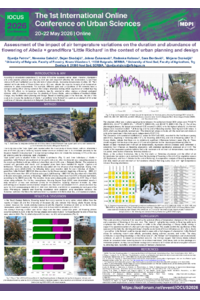
Variations in temperature have the potential to either enhance or disrupt ecological systems, yet little is known about how the plasticity of Glossy Abelia, under conditions of localised climate change, can facilitate urban planning and design. Therefore, this study focuses on changes in the duration and abundance of flowering of Abelia × grandiflora ‘Little Richard’ in Lep Izgled Park in Belgrade during the period 2023–2025. Observations were carried out using the extended BBCH scale, with recorded dates converted into day-of-year values. The accumulated heat sum for flowering onset, full flowering, and end of flowering was determined based on daily maximum and minimum air temperatures. Flowering abundance was evaluated using a 0–5 scale, where 0 indicates the absence of flowering and 5 indicates maximum flowering. The study employed descriptive statistics, the Spearman rank test, the Mann–Kendall trend test in conjunction with Sen’s slope test, and regression analysis. The results confirm that air temperature influences both the duration and abundance of flowering. The year factor proved to be significant, with 2024, identified as the globally warmest year, exhibiting the longest flowering phenophase, while flowering abundance varied depending on daily maximum and minimum air temperatures. The distribution of flowering abundance and shifts in phenological patterns suggest that the responses of Glossy Abelia represent adaptations to local conditions. This study also provides a framework for modelling the potential effects of temperature changes on the dynamics and abundance of flowering on both local and global scales. The research highlights key events in flowering patterns in order to emphasise the influence of air temperature on changes in the urban phenology of glossy abelia, with the aim of supporting the operationalisation of urban planning and park design.
Keywords
urban environments
phenophase duration
resilience
adaptation
landscape design
Poster
IOCUS 2026 POSTER sciforum-172229.pdf
A Study on Public Open Spaces in the Ger Districts of Ulaanbaatar city
Cities for People: Walkability Analysis in the Surroundings of Óvalo Gutiérrez, Miraflores District