Event submissions
Published
This submission belongs to the session S1. Urban Planning and Design of the event The 1st International Online Conference on Urban Sciences
Published date
15 May, 2026
Academic Editor
'%3e%3cpath%20d='M12.6657%2010.9104C12.4185%2010.325%2012.0599%209.79327%2011.6097%209.34482C11.1609%208.89508%2010.6293%208.5365%2010.0442%208.28888C10.0389%208.28626%2010.0337%208.28495%2010.0285%208.28233C10.8446%207.69279%2011.3752%206.73249%2011.3752%205.64904C11.3752%203.8542%209.92103%202.39999%208.1262%202.39999C6.33136%202.39999%204.87715%203.8542%204.87715%205.64904C4.87715%206.73249%205.40774%207.69279%206.22393%208.28364C6.21869%208.28626%206.21345%208.28757%206.20821%208.29019C5.62129%208.5378%205.09463%208.89284%204.64265%209.34613C4.1929%209.79493%203.83432%2010.3266%203.58671%2010.9117C3.34345%2011.4845%203.21226%2012.0987%203.20023%2012.7209C3.19988%2012.7349%203.20233%2012.7488%203.20744%2012.7619C3.21255%2012.7749%203.22022%2012.7867%203.22998%2012.7968C3.23975%2012.8068%203.25142%2012.8147%203.26431%2012.8202C3.2772%2012.8256%203.29105%2012.8284%203.30504%2012.8284H4.09109C4.14874%2012.8284%204.19459%2012.7825%204.1959%2012.7262C4.2221%2011.7148%204.62823%2010.7676%205.34617%2010.0497C6.08899%209.30683%207.0755%208.89808%208.1262%208.89808C9.17689%208.89808%2010.1634%209.30683%2010.9062%2010.0497C11.6242%2010.7676%2012.0303%2011.7148%2012.0565%2012.7262C12.0578%2012.7838%2012.1037%2012.8284%2012.1613%2012.8284H12.9474C12.9613%2012.8284%2012.9752%2012.8256%2012.9881%2012.8202C13.001%2012.8147%2013.0126%2012.8068%2013.0224%2012.7968C13.0322%2012.7867%2013.0398%2012.7749%2013.0449%2012.7619C13.0501%2012.7488%2013.0525%2012.7349%2013.0522%2012.7209C13.0391%2012.0947%2012.9094%2011.4855%2012.6657%2010.9104ZM8.1262%207.9024C7.52486%207.9024%206.9589%207.6679%206.53312%207.24211C6.10733%206.81633%205.87283%206.25037%205.87283%205.64904C5.87283%205.0477%206.10733%204.48174%206.53312%204.05596C6.9589%203.63018%207.52486%203.39567%208.1262%203.39567C8.72753%203.39567%209.29349%203.63018%209.71927%204.05596C10.1451%204.48174%2010.3796%205.0477%2010.3796%205.64904C10.3796%206.25037%2010.1451%206.81633%209.71927%207.24211C9.29349%207.6679%208.72753%207.9024%208.1262%207.9024Z'%20fill='%235D1EE1'/%3e%3c/g%3e%3c/svg%3e) Francesco Aletta
Francesco AlettaCitation
Sevim Sezi Karayazi, Necla Ece Oncul, Tugcenur Metin Parlak, The Tale of Two Troys: A Comparative Sentiment Analysis of Visitor Experiences in the Ancient City and the Museum, in Proceedings of The 1st International Online Conference on Urban Sciences, 20 May–22 May 2026, MDPI: Basel, Switzerland
Share
Email
Facebook
Twitter
LinkedIn
The Tale of Two Troys: A Comparative Sentiment Analysis of Visitor Experiences in the Ancient City and the Museum

Sevim Sezi Karayazi 1
'%3e%3cpath%20d='M12.6647%2010.9104C12.4176%2010.325%2012.0589%209.7933%2011.6088%209.34485C11.16%208.89511%2010.6283%208.53653%2010.0432%208.28891C10.038%208.28629%2010.0327%208.28498%2010.0275%208.28236C10.8437%207.69282%2011.3743%206.73252%2011.3743%205.64907C11.3743%203.85423%209.92005%202.40002%208.12522%202.40002C6.33038%202.40002%204.87618%203.85423%204.87618%205.64907C4.87618%206.73252%205.40677%207.69282%206.22296%208.28367C6.21772%208.28629%206.21248%208.2876%206.20724%208.29022C5.62031%208.53783%205.09365%208.89287%204.64167%209.34616C4.19192%209.79496%203.83334%2010.3266%203.58573%2010.9117C3.34247%2011.4846%203.21128%2012.0987%203.19925%2012.721C3.1989%2012.735%203.20135%2012.7489%203.20646%2012.7619C3.21157%2012.7749%203.21924%2012.7868%203.22901%2012.7968C3.23877%2012.8068%203.25045%2012.8148%203.26334%2012.8202C3.27623%2012.8256%203.29007%2012.8284%203.30406%2012.8284H4.09012C4.14776%2012.8284%204.19362%2012.7825%204.19493%2012.7262C4.22113%2011.7148%204.62726%2010.7676%205.34519%2010.0497C6.08802%209.30686%207.07452%208.89811%208.12522%208.89811C9.17592%208.89811%2010.1624%209.30686%2010.9052%2010.0497C11.6232%2010.7676%2012.0293%2011.7148%2012.0555%2012.7262C12.0568%2012.7839%2012.1027%2012.8284%2012.1603%2012.8284H12.9464C12.9604%2012.8284%2012.9742%2012.8256%2012.9871%2012.8202C13%2012.8148%2013.0117%2012.8068%2013.0214%2012.7968C13.0312%2012.7868%2013.0389%2012.7749%2013.044%2012.7619C13.0491%2012.7489%2013.0515%2012.735%2013.0512%2012.721C13.0381%2012.0947%2012.9084%2011.4856%2012.6647%2010.9104ZM8.12522%207.90243C7.52388%207.90243%206.95792%207.66793%206.53214%207.24215C6.10636%206.81636%205.87185%206.2504%205.87185%205.64907C5.87185%205.04773%206.10636%204.48177%206.53214%204.05599C6.95792%203.63021%207.52388%203.3957%208.12522%203.3957C8.72655%203.3957%209.29252%203.63021%209.7183%204.05599C10.1441%204.48177%2010.3786%205.04773%2010.3786%205.64907C10.3786%206.2504%2010.1441%206.81636%209.7183%207.24215C9.29252%207.66793%208.72655%207.90243%208.12522%207.90243Z'%20fill='%235D1EE1'/%3e%3c/g%3e%3c/svg%3e)
Necla Ece Oncul 1
Tugcenur Metin Parlak 1
1. Department of Architecture, Faculty of Architecture and Design, Canakkale Onsekiz Mart University, Çanakkale, Turkey
Abstract
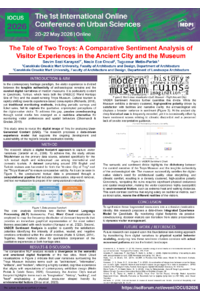
In the contemporary heritage paradigm, the visitor experience can be divided into the tangible authenticity of archaeological ruins and the digital narratives of modern museums. This distinction is particularly evident in Canakkale, Türkiye, which hosts both the UNESCO World Heritage Site of Troy and the award-winning Troya Museum. While these two entities interpret an identical historical timeline, they provide fundamentally distinct spatial and cognitive encounters. As Richards (2018) indicates, cultural tourism is rapidly shifting towards experience-based consumption, yet traditional monitoring methods including surveys and ticket sales fail to capture the qualitative perceptions of the digital-native visitor. To address this gap, Ghermandi and Sinclair (2019) advocate for passive crowdsourcing through social media as a real-time alternative to monitor visitor preferences. This study aims to reveal the digital image of Troy by analyzing User-Generated Content to determine whether visitor perceptions align with the management goals of the Troya. The research adopts a digital footprint approach (Girardin et al., 2008), and it utilizes TripAdvisor as the data source due to its rich textual depth. A balanced dataset of English and Turkish reviews (n=250) are harvested for both the "Ancient City of Troy" and the "Troya Museum". The text data are analyzed by conducting a pipeline of tokenization, stop-word removal, and normalization. The methodology combines methods from Natural Language Processing frameworks: first, Word Cloud visualization (Karayazi et al., 2022) maps the frequency distribution of dominant keywords. Second, VADER Sentiment Analysis (Hutto & Gilbert, 2014) quantifies satisfaction polarities. Reviews of the Troya Museum are expected to emphasize architectural quality and exhibition design (Metin Parlak & Celebi Seker, 2026). In contrast, reviews of the archaeological site are expected to mention environmental aspects, such as walking distances, climatic conditions, and engagement with the landscape (Oncul et al., 2023). As a result, this research proposes a data-driven experience model, and it supports the development of destination identity.
Keywords
Digital Heritage
Sentiment Analysis
Troy
TripAdvisor
Experience Model
Poster
170771_karayazi_oncul_metinparlak.pdf
Open-Data GeoAI for Short-Term Urban Land-Use/Land-Cover Forecasting in Rapidly Growing African Cities: A Reproducible Workflow and the Kinshasa (DRC) Case Study
The Quantified Public Realm: Applying Principal Component Analysis (PCA) to Urban Placemaking in Mumbai’s Bandra-Kurla Complex