Event submissions
Published
This submission belongs to the session S5. Mechanical and Aerospace Engineering of the event The 6th International Electronic Conference on Applied Sciences
Published date
03 Dec, 2025
Academic Editor
'%3e%3cpath%20d='M12.6657%2010.9104C12.4185%2010.325%2012.0599%209.79327%2011.6097%209.34482C11.1609%208.89508%2010.6293%208.5365%2010.0442%208.28888C10.0389%208.28626%2010.0337%208.28495%2010.0285%208.28233C10.8446%207.69279%2011.3752%206.73249%2011.3752%205.64904C11.3752%203.8542%209.92103%202.39999%208.1262%202.39999C6.33136%202.39999%204.87715%203.8542%204.87715%205.64904C4.87715%206.73249%205.40774%207.69279%206.22393%208.28364C6.21869%208.28626%206.21345%208.28757%206.20821%208.29019C5.62129%208.5378%205.09463%208.89284%204.64265%209.34613C4.1929%209.79493%203.83432%2010.3266%203.58671%2010.9117C3.34345%2011.4845%203.21226%2012.0987%203.20023%2012.7209C3.19988%2012.7349%203.20233%2012.7488%203.20744%2012.7619C3.21255%2012.7749%203.22022%2012.7867%203.22998%2012.7968C3.23975%2012.8068%203.25142%2012.8147%203.26431%2012.8202C3.2772%2012.8256%203.29105%2012.8284%203.30504%2012.8284H4.09109C4.14874%2012.8284%204.19459%2012.7825%204.1959%2012.7262C4.2221%2011.7148%204.62823%2010.7676%205.34617%2010.0497C6.08899%209.30683%207.0755%208.89808%208.1262%208.89808C9.17689%208.89808%2010.1634%209.30683%2010.9062%2010.0497C11.6242%2010.7676%2012.0303%2011.7148%2012.0565%2012.7262C12.0578%2012.7838%2012.1037%2012.8284%2012.1613%2012.8284H12.9474C12.9613%2012.8284%2012.9752%2012.8256%2012.9881%2012.8202C13.001%2012.8147%2013.0126%2012.8068%2013.0224%2012.7968C13.0322%2012.7867%2013.0398%2012.7749%2013.0449%2012.7619C13.0501%2012.7488%2013.0525%2012.7349%2013.0522%2012.7209C13.0391%2012.0947%2012.9094%2011.4855%2012.6657%2010.9104ZM8.1262%207.9024C7.52486%207.9024%206.9589%207.6679%206.53312%207.24211C6.10733%206.81633%205.87283%206.25037%205.87283%205.64904C5.87283%205.0477%206.10733%204.48174%206.53312%204.05596C6.9589%203.63018%207.52486%203.39567%208.1262%203.39567C8.72753%203.39567%209.29349%203.63018%209.71927%204.05596C10.1451%204.48174%2010.3796%205.0477%2010.3796%205.64904C10.3796%206.25037%2010.1451%206.81633%209.71927%207.24211C9.29349%207.6679%208.72753%207.9024%208.1262%207.9024Z'%20fill='%235D1EE1'/%3e%3c/g%3e%3c/svg%3e) André Furtado
André FurtadoCitation
Albena Doicheva, Analysis of the Shear Force in an Internal Beam–Column Connection and the Factors Significantly Affecting its Magnitude, in Proceedings of The 6th International Electronic Conference on Applied Sciences, 9 December–11 December 2025, MDPI: Basel, Switzerland
Share
Email
Facebook
Twitter
LinkedIn
Analysis of the Shear Force in an Internal Beam–Column Connection and the Factors Significantly Affecting its Magnitude

Albena Doicheva 1
1. Department of Technical Mechanics, University of Architecture, Civil Engineering and Geodesy (UACEG), Sofia 1046, Bulgaria, Bulgaria
Abstract
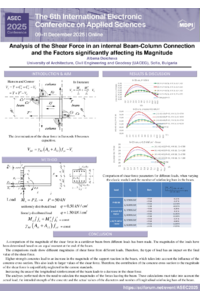
The beam–column connection is the main element in frame structures. It is particularly vulnerable to cyclic lateral loads such as earthquakes. The main reason for this is the occurrence of shear forces. The main components of this force are the forces that are transmitted from the beam to the column. A good knowledge of these forces will allow for the safe and accurate dimensioning of frame joints. In current codes of differently countries, as well as in Eurocode, beam forces are determined capacitively, based on the longitudinal reinforcing bars passing through the beam–column connection. However, this method does not take into account the involvement of the concrete section. Furthermore, this method does not allow the forces transmitted from the beam to the column to be determined on the basis of the applied load. Experimental studies conducted over the past few decades have shown the significant contribution of these two factors, concrete strength and applied load, to the shear force. Analytical solutions of beams of frame construction subjected to different types of loads provide an explanation to the issue of the significant influence of load and strength of concrete [1-2]. In this paper, numerical results obtained from the analytical studies will be shown and conclusions will be drawn supporting experimental observations from the literature.
References:
[1] A. Doicheva, Distribution of Forces in RC Interior Beam–Column Connections, Eng. Proc., 56(1), 114, 2023.
[2] A. Doicheva, Shear Force of Interior Beam–Column Joints under Symmetrical Loading with Two Transverse Forces on the Beam, Buildings, 14(9), 3028, 2024.
Keywords
larges deformations
crack on the face of the column
beam-column connection
limite state
shear force
beam
reinforced concrete
Oral Presentation
sciforum-136305_Doicheva_Presentation.pptx
Poster
sciforum-136305_Doicheva.pdf
Atto-Plasmonic sensors for Point-of-Care Tests
Altitude Control in an Unmanned Ariel Vehicle Through Deflection of Elevator