Event submissions
Published
This submission belongs to the session S5. Mechanical and Aerospace Engineering of the event The 6th International Electronic Conference on Applied Sciences
Published date
03 Dec, 2025
Academic Editor
'%3e%3cpath%20d='M12.6657%2010.9104C12.4185%2010.325%2012.0599%209.79327%2011.6097%209.34482C11.1609%208.89508%2010.6293%208.5365%2010.0442%208.28888C10.0389%208.28626%2010.0337%208.28495%2010.0285%208.28233C10.8446%207.69279%2011.3752%206.73249%2011.3752%205.64904C11.3752%203.8542%209.92103%202.39999%208.1262%202.39999C6.33136%202.39999%204.87715%203.8542%204.87715%205.64904C4.87715%206.73249%205.40774%207.69279%206.22393%208.28364C6.21869%208.28626%206.21345%208.28757%206.20821%208.29019C5.62129%208.5378%205.09463%208.89284%204.64265%209.34613C4.1929%209.79493%203.83432%2010.3266%203.58671%2010.9117C3.34345%2011.4845%203.21226%2012.0987%203.20023%2012.7209C3.19988%2012.7349%203.20233%2012.7488%203.20744%2012.7619C3.21255%2012.7749%203.22022%2012.7867%203.22998%2012.7968C3.23975%2012.8068%203.25142%2012.8147%203.26431%2012.8202C3.2772%2012.8256%203.29105%2012.8284%203.30504%2012.8284H4.09109C4.14874%2012.8284%204.19459%2012.7825%204.1959%2012.7262C4.2221%2011.7148%204.62823%2010.7676%205.34617%2010.0497C6.08899%209.30683%207.0755%208.89808%208.1262%208.89808C9.17689%208.89808%2010.1634%209.30683%2010.9062%2010.0497C11.6242%2010.7676%2012.0303%2011.7148%2012.0565%2012.7262C12.0578%2012.7838%2012.1037%2012.8284%2012.1613%2012.8284H12.9474C12.9613%2012.8284%2012.9752%2012.8256%2012.9881%2012.8202C13.001%2012.8147%2013.0126%2012.8068%2013.0224%2012.7968C13.0322%2012.7867%2013.0398%2012.7749%2013.0449%2012.7619C13.0501%2012.7488%2013.0525%2012.7349%2013.0522%2012.7209C13.0391%2012.0947%2012.9094%2011.4855%2012.6657%2010.9104ZM8.1262%207.9024C7.52486%207.9024%206.9589%207.6679%206.53312%207.24211C6.10733%206.81633%205.87283%206.25037%205.87283%205.64904C5.87283%205.0477%206.10733%204.48174%206.53312%204.05596C6.9589%203.63018%207.52486%203.39567%208.1262%203.39567C8.72753%203.39567%209.29349%203.63018%209.71927%204.05596C10.1451%204.48174%2010.3796%205.0477%2010.3796%205.64904C10.3796%206.25037%2010.1451%206.81633%209.71927%207.24211C9.29349%207.6679%208.72753%207.9024%208.1262%207.9024Z'%20fill='%235D1EE1'/%3e%3c/g%3e%3c/svg%3e) André Furtado
André FurtadoCitation
Muhammad Hashier Muneeb Farrukh, Dr. Syed Irtiza Ali Shah, Ibtesam Hayat, Hafiz Usama Tanveer, Rai Faisal Aslam, Hasham Tanveer, Altitude Control in an Unmanned Ariel Vehicle Through Deflection of Elevator, in Proceedings of The 6th International Electronic Conference on Applied Sciences, 9 December–11 December 2025, MDPI: Basel, Switzerland
Share
Email
Facebook
Twitter
LinkedIn
Altitude Control in an Unmanned Ariel Vehicle Through Deflection of Elevator
'%3e%3cpath%20d='M12.6647%2010.9104C12.4176%2010.325%2012.0589%209.7933%2011.6088%209.34485C11.16%208.89511%2010.6283%208.53653%2010.0432%208.28891C10.038%208.28629%2010.0327%208.28498%2010.0275%208.28236C10.8437%207.69282%2011.3743%206.73252%2011.3743%205.64907C11.3743%203.85423%209.92005%202.40002%208.12522%202.40002C6.33038%202.40002%204.87618%203.85423%204.87618%205.64907C4.87618%206.73252%205.40677%207.69282%206.22296%208.28367C6.21772%208.28629%206.21248%208.2876%206.20724%208.29022C5.62031%208.53783%205.09365%208.89287%204.64167%209.34616C4.19192%209.79496%203.83334%2010.3266%203.58573%2010.9117C3.34247%2011.4846%203.21128%2012.0987%203.19925%2012.721C3.1989%2012.735%203.20135%2012.7489%203.20646%2012.7619C3.21157%2012.7749%203.21924%2012.7868%203.22901%2012.7968C3.23877%2012.8068%203.25045%2012.8148%203.26334%2012.8202C3.27623%2012.8256%203.29007%2012.8284%203.30406%2012.8284H4.09012C4.14776%2012.8284%204.19362%2012.7825%204.19493%2012.7262C4.22113%2011.7148%204.62726%2010.7676%205.34519%2010.0497C6.08802%209.30686%207.07452%208.89811%208.12522%208.89811C9.17592%208.89811%2010.1624%209.30686%2010.9052%2010.0497C11.6232%2010.7676%2012.0293%2011.7148%2012.0555%2012.7262C12.0568%2012.7839%2012.1027%2012.8284%2012.1603%2012.8284H12.9464C12.9604%2012.8284%2012.9742%2012.8256%2012.9871%2012.8202C13%2012.8148%2013.0117%2012.8068%2013.0214%2012.7968C13.0312%2012.7868%2013.0389%2012.7749%2013.044%2012.7619C13.0491%2012.7489%2013.0515%2012.735%2013.0512%2012.721C13.0381%2012.0947%2012.9084%2011.4856%2012.6647%2010.9104ZM8.12522%207.90243C7.52388%207.90243%206.95792%207.66793%206.53214%207.24215C6.10636%206.81636%205.87185%206.2504%205.87185%205.64907C5.87185%205.04773%206.10636%204.48177%206.53214%204.05599C6.95792%203.63021%207.52388%203.3957%208.12522%203.3957C8.72655%203.3957%209.29252%203.63021%209.7183%204.05599C10.1441%204.48177%2010.3786%205.04773%2010.3786%205.64907C10.3786%206.2504%2010.1441%206.81636%209.7183%207.24215C9.29252%207.66793%208.72655%207.90243%208.12522%207.90243Z'%20fill='%235D1EE1'/%3e%3c/g%3e%3c/svg%3e)
Muhammad Hashier Muneeb Farrukh 1
Dr. Syed Irtiza Ali Shah 2
Ibtesam Hayat 3
Hafiz Usama Tanveer 4
Rai Faisal Aslam 5
Hasham Tanveer 6
1. Engineering Management, St. Cloud State University, Plymouth, Minneapolis, MN, 55414, United States, Pakistan
2. Mechanical Engineering, National University of Science and Technology, Islamabad, 44000, Pakistan, Pakistan
3. Mechanical Engineering, Air University, Islamabad, 44000, Pakistan, Pakistan
4. Civil and Environmental Engineering, George Mason University, Fairfax, VA, 22030, United States, USA
5. Engineering Management, St. Cloud State University, Plymouth, St. Cloud, MN, 56301, United States, USA
6. Computer Science, Drexel University, Philadelphia, Pennsylvania, 19104, United States, USA
Abstract
This research is about controlling the altitude of the Unmanned Ariel Vehicle (UAV) through the elevator. Elevators are flight control surfaces, which control lateral altitude by changing the pitch balance. The elevators are usually hinged to a fixed or adjustable rear surface, making as a whole, a tailplane or horizontal stabilizer. The elevator is used to control the altitude by its movement which gives lift to the UAV. It consists of two loops: an inner-loop controller to achieve stability and robustness to expected parameter uncertainty and an outer loop for tracking reference performances. In the past, people have done work on its longitudinal maneuver using elevator control input and in this research, we are going to control vertical height using elevator control input of the Unmanned Ariel Vehicle. This work eyes on altitude maintenance of UAV through a dual laser and ultra-sonic deflection, for graphing the surrounding and maintaining the minimum maintained altitude. The angle deflection along with the thrust from propulsion system is matched and guided by the system for the gain or loss of altitude over desired range of distance. The significance of the system would be efficient increase and decrease of altitude of UAV along with easier piloted drone; and in military aspects the stealth enhancements for low chances of being detected. The expected result increases efficiency of any Unmanned Aerial Vehicle along with low fuel consumption because of achieving desired altitude over short range.
Keywords
UAV
Altitude Control
Deflector
Control
Oral Presentation
Final-Altitude Control in an Unmanned Aerial Vehicle Through Deflection of Elevator.pptx
Poster
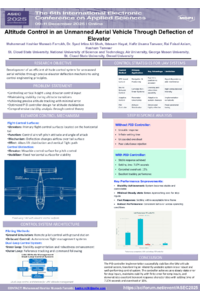
CONFERENCE POSTER-ASEC 2026.pdf
Analysis of the Shear Force in an Internal Beam–Column Connection and the Factors Significantly Affecting its Magnitude
A Quantum-Based Parallel Model Approach for the Classification of Alzheimer’s Disease Stages: An Application on OASIS-1 and ADNI Datasets