Event submissions
Published
This submission belongs to the session S3. Computing and Artificial Intelligence of the event The 6th International Electronic Conference on Applied Sciences
Published date
03 Dec, 2025
Academic Editor
'%3e%3cpath%20d='M12.6657%2010.9104C12.4185%2010.325%2012.0599%209.79327%2011.6097%209.34482C11.1609%208.89508%2010.6293%208.5365%2010.0442%208.28888C10.0389%208.28626%2010.0337%208.28495%2010.0285%208.28233C10.8446%207.69279%2011.3752%206.73249%2011.3752%205.64904C11.3752%203.8542%209.92103%202.39999%208.1262%202.39999C6.33136%202.39999%204.87715%203.8542%204.87715%205.64904C4.87715%206.73249%205.40774%207.69279%206.22393%208.28364C6.21869%208.28626%206.21345%208.28757%206.20821%208.29019C5.62129%208.5378%205.09463%208.89284%204.64265%209.34613C4.1929%209.79493%203.83432%2010.3266%203.58671%2010.9117C3.34345%2011.4845%203.21226%2012.0987%203.20023%2012.7209C3.19988%2012.7349%203.20233%2012.7488%203.20744%2012.7619C3.21255%2012.7749%203.22022%2012.7867%203.22998%2012.7968C3.23975%2012.8068%203.25142%2012.8147%203.26431%2012.8202C3.2772%2012.8256%203.29105%2012.8284%203.30504%2012.8284H4.09109C4.14874%2012.8284%204.19459%2012.7825%204.1959%2012.7262C4.2221%2011.7148%204.62823%2010.7676%205.34617%2010.0497C6.08899%209.30683%207.0755%208.89808%208.1262%208.89808C9.17689%208.89808%2010.1634%209.30683%2010.9062%2010.0497C11.6242%2010.7676%2012.0303%2011.7148%2012.0565%2012.7262C12.0578%2012.7838%2012.1037%2012.8284%2012.1613%2012.8284H12.9474C12.9613%2012.8284%2012.9752%2012.8256%2012.9881%2012.8202C13.001%2012.8147%2013.0126%2012.8068%2013.0224%2012.7968C13.0322%2012.7867%2013.0398%2012.7749%2013.0449%2012.7619C13.0501%2012.7488%2013.0525%2012.7349%2013.0522%2012.7209C13.0391%2012.0947%2012.9094%2011.4855%2012.6657%2010.9104ZM8.1262%207.9024C7.52486%207.9024%206.9589%207.6679%206.53312%207.24211C6.10733%206.81633%205.87283%206.25037%205.87283%205.64904C5.87283%205.0477%206.10733%204.48174%206.53312%204.05596C6.9589%203.63018%207.52486%203.39567%208.1262%203.39567C8.72753%203.39567%209.29349%203.63018%209.71927%204.05596C10.1451%204.48174%2010.3796%205.0477%2010.3796%205.64904C10.3796%206.25037%2010.1451%206.81633%209.71927%207.24211C9.29349%207.6679%208.72753%207.9024%208.1262%207.9024Z'%20fill='%235D1EE1'/%3e%3c/g%3e%3c/svg%3e) Lucia Billeci
Lucia BilleciCitation
Abdullahi Egigogo Raji, Idris Ismaila, Morufu Olalere, Barira Hamisu, Abisoye Opeyemi Aderiike, Ojeniyi Adebayo Joseph, Spatial and Temporal Feature Fusion for Enhanced Phishing Attack Detection in Web Environments, in Proceedings of The 6th International Electronic Conference on Applied Sciences, 9 December–11 December 2025, MDPI: Basel, Switzerland
Share
Email
Facebook
Twitter
LinkedIn
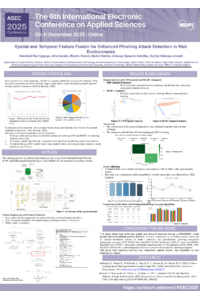
Spatial and Temporal Feature Fusion for Enhanced Phishing Attack Detection in Web Environments
'%3e%3cpath%20d='M12.6647%2010.9104C12.4176%2010.325%2012.0589%209.7933%2011.6088%209.34485C11.16%208.89511%2010.6283%208.53653%2010.0432%208.28891C10.038%208.28629%2010.0327%208.28498%2010.0275%208.28236C10.8437%207.69282%2011.3743%206.73252%2011.3743%205.64907C11.3743%203.85423%209.92005%202.40002%208.12522%202.40002C6.33038%202.40002%204.87618%203.85423%204.87618%205.64907C4.87618%206.73252%205.40677%207.69282%206.22296%208.28367C6.21772%208.28629%206.21248%208.2876%206.20724%208.29022C5.62031%208.53783%205.09365%208.89287%204.64167%209.34616C4.19192%209.79496%203.83334%2010.3266%203.58573%2010.9117C3.34247%2011.4846%203.21128%2012.0987%203.19925%2012.721C3.1989%2012.735%203.20135%2012.7489%203.20646%2012.7619C3.21157%2012.7749%203.21924%2012.7868%203.22901%2012.7968C3.23877%2012.8068%203.25045%2012.8148%203.26334%2012.8202C3.27623%2012.8256%203.29007%2012.8284%203.30406%2012.8284H4.09012C4.14776%2012.8284%204.19362%2012.7825%204.19493%2012.7262C4.22113%2011.7148%204.62726%2010.7676%205.34519%2010.0497C6.08802%209.30686%207.07452%208.89811%208.12522%208.89811C9.17592%208.89811%2010.1624%209.30686%2010.9052%2010.0497C11.6232%2010.7676%2012.0293%2011.7148%2012.0555%2012.7262C12.0568%2012.7839%2012.1027%2012.8284%2012.1603%2012.8284H12.9464C12.9604%2012.8284%2012.9742%2012.8256%2012.9871%2012.8202C13%2012.8148%2013.0117%2012.8068%2013.0214%2012.7968C13.0312%2012.7868%2013.0389%2012.7749%2013.044%2012.7619C13.0491%2012.7489%2013.0515%2012.735%2013.0512%2012.721C13.0381%2012.0947%2012.9084%2011.4856%2012.6647%2010.9104ZM8.12522%207.90243C7.52388%207.90243%206.95792%207.66793%206.53214%207.24215C6.10636%206.81636%205.87185%206.2504%205.87185%205.64907C5.87185%205.04773%206.10636%204.48177%206.53214%204.05599C6.95792%203.63021%207.52388%203.3957%208.12522%203.3957C8.72655%203.3957%209.29252%203.63021%209.7183%204.05599C10.1441%204.48177%2010.3786%205.04773%2010.3786%205.64907C10.3786%206.2504%2010.1441%206.81636%209.7183%207.24215C9.29252%207.66793%208.72655%207.90243%208.12522%207.90243Z'%20fill='%235D1EE1'/%3e%3c/g%3e%3c/svg%3e)
Abdullahi Egigogo Raji 1,2
Idris Ismaila 1
Morufu Olalere 3
Barira Hamisu 4
Abisoye Opeyemi Aderiike 5
Ojeniyi Adebayo Joseph 1
1. Department of Cyber Security Science, School of Information Communication Technology, Federal University of Technology, Gidan Kwanu, P.M.B 65, Minna, Niger State, Nigeria, Nigeria
2. Department of Software Engineering and Cyber Security, College of Computing and Information Science Al-Qalam University, Tafawa Balewa Way, Dutsin-ma, Road PMB 213, Kastina, Nigeria
3. National Open University of Nigeria (NOUN) Plot 91, Cadastral Zone Nnamdi Azikiwe Expressway Jabi, Abuja, Nigeria, Nigeria
4. Department of Software Engineering and Cyber Security, College of Computing and Information Science Al-Qalam University, Tafawa Balewa Way, Dutsin-ma, Road PMB 213, Kastina, Nigeria, Nigeria
5. Department of Computer Science, School of Information Communication Technology, Federal university of technology, Gidan Kwanu, P.M.B 65, Minna, Niger State, Nigeria, Nigeria
Abstract
Phishing attacks remain a dominant and evolving cybersecurity threat, exploiting deceptive techniques to compromise user credentials and sensitive data. Traditional detection systems, often rule-based or reliant on manually engineered features, struggle to cope with the dynamic nature of phishing patterns. This study proposes a hybridized deep learning model that integrates Convolutional Neural Networks (CNN) and Bidirectional Gated Recurrent Units (BiGRU) to effectively detect phishing websites. CNN is employed for spatial feature extraction from URL and HTML structures, while BiGRU captures temporal dependencies, enabling a comprehensive understanding of phishing behaviors. The model processes a rich dataset of 80,000 website instances—sourced from PhishTank, OpenPhish, and other repositories, and applies Min-Max scaling during preprocessing to normalize feature values. A dual-pathway architecture fuses spatial and sequential features into a unified representation, enhancing detection performance. Experimental evaluations using train–test split and 5-fold stratified cross-validation demonstrate outstanding results, achieving 99.97% accuracy, 99.98% recall, and 99.96% specificity. The model further exhibits strong generalizability when tested on an external dataset, reinforcing its robustness across diverse phishing patterns. Comparative analysis with existing deep learning methods, including CNN-LSTM and CNN-BiLSTM, confirms that the CNN-BiGRU architecture delivers superior performance with reduced false positives and false negatives. This work highlights the potential of hybrid deep learning frameworks in building resilient, scalable, and real-time phishing detection systems suited for deployment in modern web security infrastructures.
Keywords
Deep Learning
Phishing Detection
Convolutional Neural Networks
Bidirectional Gated Recurrent Units
Poster
Poster Presentation.pdf
Low-wetting ultrasonic micro-mist as a postharvest treatment for sliced mushrooms (Agaricus bisporus)
In Vitro Inhibition of Cardiometabolic Health-Related Enzymes by Monofloral Stingless Bee Honey