Event submissions
Published
This submission belongs to the session S3. Computing and Artificial Intelligence of the event The 6th International Electronic Conference on Applied Sciences
Published date
03 Dec, 2025
Academic Editor
'%3e%3cpath%20d='M12.6657%2010.9104C12.4185%2010.325%2012.0599%209.79327%2011.6097%209.34482C11.1609%208.89508%2010.6293%208.5365%2010.0442%208.28888C10.0389%208.28626%2010.0337%208.28495%2010.0285%208.28233C10.8446%207.69279%2011.3752%206.73249%2011.3752%205.64904C11.3752%203.8542%209.92103%202.39999%208.1262%202.39999C6.33136%202.39999%204.87715%203.8542%204.87715%205.64904C4.87715%206.73249%205.40774%207.69279%206.22393%208.28364C6.21869%208.28626%206.21345%208.28757%206.20821%208.29019C5.62129%208.5378%205.09463%208.89284%204.64265%209.34613C4.1929%209.79493%203.83432%2010.3266%203.58671%2010.9117C3.34345%2011.4845%203.21226%2012.0987%203.20023%2012.7209C3.19988%2012.7349%203.20233%2012.7488%203.20744%2012.7619C3.21255%2012.7749%203.22022%2012.7867%203.22998%2012.7968C3.23975%2012.8068%203.25142%2012.8147%203.26431%2012.8202C3.2772%2012.8256%203.29105%2012.8284%203.30504%2012.8284H4.09109C4.14874%2012.8284%204.19459%2012.7825%204.1959%2012.7262C4.2221%2011.7148%204.62823%2010.7676%205.34617%2010.0497C6.08899%209.30683%207.0755%208.89808%208.1262%208.89808C9.17689%208.89808%2010.1634%209.30683%2010.9062%2010.0497C11.6242%2010.7676%2012.0303%2011.7148%2012.0565%2012.7262C12.0578%2012.7838%2012.1037%2012.8284%2012.1613%2012.8284H12.9474C12.9613%2012.8284%2012.9752%2012.8256%2012.9881%2012.8202C13.001%2012.8147%2013.0126%2012.8068%2013.0224%2012.7968C13.0322%2012.7867%2013.0398%2012.7749%2013.0449%2012.7619C13.0501%2012.7488%2013.0525%2012.7349%2013.0522%2012.7209C13.0391%2012.0947%2012.9094%2011.4855%2012.6657%2010.9104ZM8.1262%207.9024C7.52486%207.9024%206.9589%207.6679%206.53312%207.24211C6.10733%206.81633%205.87283%206.25037%205.87283%205.64904C5.87283%205.0477%206.10733%204.48174%206.53312%204.05596C6.9589%203.63018%207.52486%203.39567%208.1262%203.39567C8.72753%203.39567%209.29349%203.63018%209.71927%204.05596C10.1451%204.48174%2010.3796%205.0477%2010.3796%205.64904C10.3796%206.25037%2010.1451%206.81633%209.71927%207.24211C9.29349%207.6679%208.72753%207.9024%208.1262%207.9024Z'%20fill='%235D1EE1'/%3e%3c/g%3e%3c/svg%3e) Eugenio Vocaturo
Eugenio VocaturoCitation
Angelica Lo Duca, Toward Intelligent Agent-Based Scientific Storytelling, in Proceedings of The 6th International Electronic Conference on Applied Sciences, 9 December–11 December 2025, MDPI: Basel, Switzerland
Share
Email
Facebook
Twitter
LinkedIn
Toward Intelligent Agent-Based Scientific Storytelling

Angelica Lo Duca 1
1. Institute of Informatics and Telematics, National Research Council, via G. Moruzzi, 1, Pisa, 56124, Italy, Italy
Abstract
Introduction
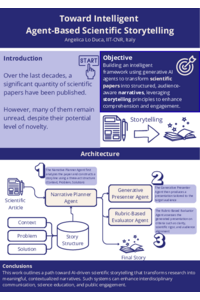
Over the past few decades, a significant quantity of scientific papers have been published. However, many of them remain unread, despite their potential level of novelty. Traditional dissemination formats, based on static papers or technical reports, are often inaccessible to policymakers, executives, or the general public. This paper proposes a vision for an intelligent framework that utilizes Generative AI agents to transform scientific papers into structured, audience-aware narratives, leveraging storytelling principles to enhance comprehension and engagement.
Methods
The proposed methodology introduces a multi-agent pipeline with three components. A Narrative Planner Agent first analyzes the paper and constructs a storyline using a three-act structure (Context, Problem, and Solution) [1]. A Generative Presenter Agent then produces a presentation tailored to the target audience. Finally, a Rubric-Based Evaluator Agent assesses the generated presentation on criteria such as clarity, scientific rigor, and audience alignment. The entire process is envisioned within an open-source workflow automation environment (e.g., n8n [2]) to ensure scalability and modularity.
Results
At this stage, the methodology is in the design phase. However, preliminary texts in other domains have demonstrated that Generative AI can produce audience-based stories originating from domain-specific material [3].
Conclusions
This work outlines a path toward AI-driven scientific storytelling, where research is transformed into meaningful, contextualized narratives. Such systems could pave the way towards interdisciplinary communication, science education, and public engagement in applied sciences.
Keywords
Artificial Intelligence
Scientific Storytelling
Multiagent Systems
Poster
Toward Intelligent Agent-Based Scientific Storytelling.pdf
Synthesis and Biological Investigations of Vanillin and its Nitrated Derivative
Evaluation of the In Vitro Antioxidant and Anti inflammatory Potentials of Artemisia arborescens Aqueous and Hydro ethanolic Extracts : Insights from Moroccan Ethnopharmacology.