Event submissions
Published
This submission belongs to the session S4. Infection Biology of the event The 1st International Online Conference on Biology
Published date
05 Feb, 2026
Academic Editor
'%3e%3cpath%20d='M12.6657%2010.9104C12.4185%2010.325%2012.0599%209.79327%2011.6097%209.34482C11.1609%208.89508%2010.6293%208.5365%2010.0442%208.28888C10.0389%208.28626%2010.0337%208.28495%2010.0285%208.28233C10.8446%207.69279%2011.3752%206.73249%2011.3752%205.64904C11.3752%203.8542%209.92103%202.39999%208.1262%202.39999C6.33136%202.39999%204.87715%203.8542%204.87715%205.64904C4.87715%206.73249%205.40774%207.69279%206.22393%208.28364C6.21869%208.28626%206.21345%208.28757%206.20821%208.29019C5.62129%208.5378%205.09463%208.89284%204.64265%209.34613C4.1929%209.79493%203.83432%2010.3266%203.58671%2010.9117C3.34345%2011.4845%203.21226%2012.0987%203.20023%2012.7209C3.19988%2012.7349%203.20233%2012.7488%203.20744%2012.7619C3.21255%2012.7749%203.22022%2012.7867%203.22998%2012.7968C3.23975%2012.8068%203.25142%2012.8147%203.26431%2012.8202C3.2772%2012.8256%203.29105%2012.8284%203.30504%2012.8284H4.09109C4.14874%2012.8284%204.19459%2012.7825%204.1959%2012.7262C4.2221%2011.7148%204.62823%2010.7676%205.34617%2010.0497C6.08899%209.30683%207.0755%208.89808%208.1262%208.89808C9.17689%208.89808%2010.1634%209.30683%2010.9062%2010.0497C11.6242%2010.7676%2012.0303%2011.7148%2012.0565%2012.7262C12.0578%2012.7838%2012.1037%2012.8284%2012.1613%2012.8284H12.9474C12.9613%2012.8284%2012.9752%2012.8256%2012.9881%2012.8202C13.001%2012.8147%2013.0126%2012.8068%2013.0224%2012.7968C13.0322%2012.7867%2013.0398%2012.7749%2013.0449%2012.7619C13.0501%2012.7488%2013.0525%2012.7349%2013.0522%2012.7209C13.0391%2012.0947%2012.9094%2011.4855%2012.6657%2010.9104ZM8.1262%207.9024C7.52486%207.9024%206.9589%207.6679%206.53312%207.24211C6.10733%206.81633%205.87283%206.25037%205.87283%205.64904C5.87283%205.0477%206.10733%204.48174%206.53312%204.05596C6.9589%203.63018%207.52486%203.39567%208.1262%203.39567C8.72753%203.39567%209.29349%203.63018%209.71927%204.05596C10.1451%204.48174%2010.3796%205.0477%2010.3796%205.64904C10.3796%206.25037%2010.1451%206.81633%209.71927%207.24211C9.29349%207.6679%208.72753%207.9024%208.1262%207.9024Z'%20fill='%235D1EE1'/%3e%3c/g%3e%3c/svg%3e) Oswaldo Palenzuela
Oswaldo PalenzuelaCitation
Mrinalinee Pandit, Subhasis Chattopadhyay, Situl Mahanta, INTRACELLULAR MECHANISM OF EXPERIMENTAL IMMUNOSUPPRESSION: A COMPARATIVE STUDY IN T CELLS AND MACROPHAGES, in Proceedings of The 1st International Online Conference on Biology, 10 February–12 February 2026, MDPI: Basel, Switzerland
Share
Email
Facebook
Twitter
LinkedIn
INTRACELLULAR MECHANISM OF EXPERIMENTAL IMMUNOSUPPRESSION: A COMPARATIVE STUDY IN T CELLS AND MACROPHAGES
'%3e%3cpath%20d='M12.6647%2010.9104C12.4176%2010.325%2012.0589%209.7933%2011.6088%209.34485C11.16%208.89511%2010.6283%208.53653%2010.0432%208.28891C10.038%208.28629%2010.0327%208.28498%2010.0275%208.28236C10.8437%207.69282%2011.3743%206.73252%2011.3743%205.64907C11.3743%203.85423%209.92005%202.40002%208.12522%202.40002C6.33038%202.40002%204.87618%203.85423%204.87618%205.64907C4.87618%206.73252%205.40677%207.69282%206.22296%208.28367C6.21772%208.28629%206.21248%208.2876%206.20724%208.29022C5.62031%208.53783%205.09365%208.89287%204.64167%209.34616C4.19192%209.79496%203.83334%2010.3266%203.58573%2010.9117C3.34247%2011.4846%203.21128%2012.0987%203.19925%2012.721C3.1989%2012.735%203.20135%2012.7489%203.20646%2012.7619C3.21157%2012.7749%203.21924%2012.7868%203.22901%2012.7968C3.23877%2012.8068%203.25045%2012.8148%203.26334%2012.8202C3.27623%2012.8256%203.29007%2012.8284%203.30406%2012.8284H4.09012C4.14776%2012.8284%204.19362%2012.7825%204.19493%2012.7262C4.22113%2011.7148%204.62726%2010.7676%205.34519%2010.0497C6.08802%209.30686%207.07452%208.89811%208.12522%208.89811C9.17592%208.89811%2010.1624%209.30686%2010.9052%2010.0497C11.6232%2010.7676%2012.0293%2011.7148%2012.0555%2012.7262C12.0568%2012.7839%2012.1027%2012.8284%2012.1603%2012.8284H12.9464C12.9604%2012.8284%2012.9742%2012.8256%2012.9871%2012.8202C13%2012.8148%2013.0117%2012.8068%2013.0214%2012.7968C13.0312%2012.7868%2013.0389%2012.7749%2013.044%2012.7619C13.0491%2012.7489%2013.0515%2012.735%2013.0512%2012.721C13.0381%2012.0947%2012.9084%2011.4856%2012.6647%2010.9104ZM8.12522%207.90243C7.52388%207.90243%206.95792%207.66793%206.53214%207.24215C6.10636%206.81636%205.87185%206.2504%205.87185%205.64907C5.87185%205.04773%206.10636%204.48177%206.53214%204.05599C6.95792%203.63021%207.52388%203.3957%208.12522%203.3957C8.72655%203.3957%209.29252%203.63021%209.7183%204.05599C10.1441%204.48177%2010.3786%205.04773%2010.3786%205.64907C10.3786%206.2504%2010.1441%206.81636%209.7183%207.24215C9.29252%207.66793%208.72655%207.90243%208.12522%207.90243Z'%20fill='%235D1EE1'/%3e%3c/g%3e%3c/svg%3e)
Mrinalinee Pandit 1
Situl Mahanta 1
Subhasis Chattopadhyay 1
1. School of Biological Sciences (SBS), National Institute of Science Education and Research (NISER), Bhubaneswar, India, India
Abstract
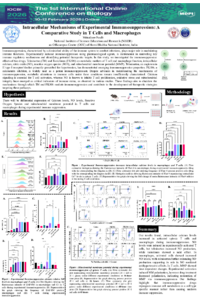
Immunosuppression, characterized by a diminished ability of the immune system to combat infections, plays major role in modulating immune functions. Experimentally induced immunosuppression using pharmacological agents, is instrumental in unraveling key immune regulatory mechanisms and identifying potential therapeutic targets. In this study, we investigated the immunosuppressive effects of two drugs, Telmisartan (TM) and Tacrolimus (FK506) on metabolic markers of T cell and macrophage function, intracellular calcium, nitric oxide (NO), reactive oxygen species (ROS), and mitochondrial membrane potential (MMP). Telmisartan, an angiotensin II type 1 receptor blocker primarily prescribed for hypertension, has demonstrated emerging immunosuppressive properties. FK506, a calcineurin inhibitor, is widely used as a potent immunosuppressant. Despite advances in understanding the mechanisms of immunosuppression, metabolic alterations in immune cells under these conditions remain insufficiently characterized. Calcium signaling is essential for T cell activation, whereas NO is known to inhibit T cell proliferation, oxidative stress and mitochondrial integrity have emerged as critical indicators of immune status, as observed in various studies. We employed RAW 264.7 murine macrophage cell line and primary splenic T cells isolated ex vivo from 8 week old C57BL/6 mice, and subsequently analyzed in vitro. Our results found, intracellular calcium levels increased in activated splenic T cells and macrophages during immunosuppression. NO levels were reduced in experimentally activated T cells, but telmisartan increased NO production, while tacrolimus showed a mild effect. In macrophages, activated cells showed increased NO levels, with telmisartan further enhancing NO production supporting its role in NO mediated antihypertensive effects. ROS levels were also increased during immunosuppression in macrophages. In T cells, MMP showed time dependent changes. Experimental activation induced MM polarisation, however drug treatment decreased polarization, indicating restoration of MMP via immunosuppression Our findings highlight that immunosuppressive drugs reprogram immune cell metabolism in a cell type specific manner rather than causing uniform immune suppression.
Keywords
Inflammation
Immunosuppression
Telmisartan (TM)
Tacrolimus (FK506)
Nitric oxide (NO)
Reactive oxygen species (ROS)
Mitochondrial health
T-cell activation
Autoimmune diseases
Poster
confposter(1).pdf
Trends in genome composition across the transition to complex multicellularity
Life cycle, Age and stage-specific life table parameters of green lacewing, Apertochrysa astur (Banks) (Neuroptera: Chrysopidae) fed on invasive coconut rugose spiralling whitefly, Aleurodicus rugioperculatus Martin