Event submissions
EventsThe 5th International Electronic Conference on Brain Sciences & 1st International Electronic Conference on Neurosciences
Published
This submission belongs to the session S2. Cellular and Molecular Neuroscience of the event The 5th International Electronic Conference on Brain Sciences & 1st International Electronic Conference on Neurosciences
Published date
04 Mar, 2026
Academic Editor
'%3e%3cpath%20d='M12.6657%2010.9104C12.4185%2010.325%2012.0599%209.79327%2011.6097%209.34482C11.1609%208.89508%2010.6293%208.5365%2010.0442%208.28888C10.0389%208.28626%2010.0337%208.28495%2010.0285%208.28233C10.8446%207.69279%2011.3752%206.73249%2011.3752%205.64904C11.3752%203.8542%209.92103%202.39999%208.1262%202.39999C6.33136%202.39999%204.87715%203.8542%204.87715%205.64904C4.87715%206.73249%205.40774%207.69279%206.22393%208.28364C6.21869%208.28626%206.21345%208.28757%206.20821%208.29019C5.62129%208.5378%205.09463%208.89284%204.64265%209.34613C4.1929%209.79493%203.83432%2010.3266%203.58671%2010.9117C3.34345%2011.4845%203.21226%2012.0987%203.20023%2012.7209C3.19988%2012.7349%203.20233%2012.7488%203.20744%2012.7619C3.21255%2012.7749%203.22022%2012.7867%203.22998%2012.7968C3.23975%2012.8068%203.25142%2012.8147%203.26431%2012.8202C3.2772%2012.8256%203.29105%2012.8284%203.30504%2012.8284H4.09109C4.14874%2012.8284%204.19459%2012.7825%204.1959%2012.7262C4.2221%2011.7148%204.62823%2010.7676%205.34617%2010.0497C6.08899%209.30683%207.0755%208.89808%208.1262%208.89808C9.17689%208.89808%2010.1634%209.30683%2010.9062%2010.0497C11.6242%2010.7676%2012.0303%2011.7148%2012.0565%2012.7262C12.0578%2012.7838%2012.1037%2012.8284%2012.1613%2012.8284H12.9474C12.9613%2012.8284%2012.9752%2012.8256%2012.9881%2012.8202C13.001%2012.8147%2013.0126%2012.8068%2013.0224%2012.7968C13.0322%2012.7867%2013.0398%2012.7749%2013.0449%2012.7619C13.0501%2012.7488%2013.0525%2012.7349%2013.0522%2012.7209C13.0391%2012.0947%2012.9094%2011.4855%2012.6657%2010.9104ZM8.1262%207.9024C7.52486%207.9024%206.9589%207.6679%206.53312%207.24211C6.10733%206.81633%205.87283%206.25037%205.87283%205.64904C5.87283%205.0477%206.10733%204.48174%206.53312%204.05596C6.9589%203.63018%207.52486%203.39567%208.1262%203.39567C8.72753%203.39567%209.29349%203.63018%209.71927%204.05596C10.1451%204.48174%2010.3796%205.0477%2010.3796%205.64904C10.3796%206.25037%2010.1451%206.81633%209.71927%207.24211C9.29349%207.6679%208.72753%207.9024%208.1262%207.9024Z'%20fill='%235D1EE1'/%3e%3c/g%3e%3c/svg%3e) Keehoon Lee
Keehoon LeeCitation
Olena Gennadiivna Aliyeva, Igor Fedorovich Belenichev, Olena Olexandrivna Popazova, Olexiy Goncharov, CONCOMITANCE OF ENDOTHELIUM DISORDERS IN THE BRAIN AND HEART VESSELS IN ISCHEMIC HEART DISEASE, in Proceedings of The 5th International Electronic Conference on Brain Sciences & 1st International Electronic Conference on Neurosciences, 9 March–11 March 2026, MDPI: Basel, Switzerland
Share
Email
Facebook
Twitter
LinkedIn
CONCOMITANCE OF ENDOTHELIUM DISORDERS IN THE BRAIN AND HEART VESSELS IN ISCHEMIC HEART DISEASE

Olena Gennadiivna Aliyeva 1
'%3e%3cpath%20d='M12.6647%2010.9104C12.4176%2010.325%2012.0589%209.7933%2011.6088%209.34485C11.16%208.89511%2010.6283%208.53653%2010.0432%208.28891C10.038%208.28629%2010.0327%208.28498%2010.0275%208.28236C10.8437%207.69282%2011.3743%206.73252%2011.3743%205.64907C11.3743%203.85423%209.92005%202.40002%208.12522%202.40002C6.33038%202.40002%204.87618%203.85423%204.87618%205.64907C4.87618%206.73252%205.40677%207.69282%206.22296%208.28367C6.21772%208.28629%206.21248%208.2876%206.20724%208.29022C5.62031%208.53783%205.09365%208.89287%204.64167%209.34616C4.19192%209.79496%203.83334%2010.3266%203.58573%2010.9117C3.34247%2011.4846%203.21128%2012.0987%203.19925%2012.721C3.1989%2012.735%203.20135%2012.7489%203.20646%2012.7619C3.21157%2012.7749%203.21924%2012.7868%203.22901%2012.7968C3.23877%2012.8068%203.25045%2012.8148%203.26334%2012.8202C3.27623%2012.8256%203.29007%2012.8284%203.30406%2012.8284H4.09012C4.14776%2012.8284%204.19362%2012.7825%204.19493%2012.7262C4.22113%2011.7148%204.62726%2010.7676%205.34519%2010.0497C6.08802%209.30686%207.07452%208.89811%208.12522%208.89811C9.17592%208.89811%2010.1624%209.30686%2010.9052%2010.0497C11.6232%2010.7676%2012.0293%2011.7148%2012.0555%2012.7262C12.0568%2012.7839%2012.1027%2012.8284%2012.1603%2012.8284H12.9464C12.9604%2012.8284%2012.9742%2012.8256%2012.9871%2012.8202C13%2012.8148%2013.0117%2012.8068%2013.0214%2012.7968C13.0312%2012.7868%2013.0389%2012.7749%2013.044%2012.7619C13.0491%2012.7489%2013.0515%2012.735%2013.0512%2012.721C13.0381%2012.0947%2012.9084%2011.4856%2012.6647%2010.9104ZM8.12522%207.90243C7.52388%207.90243%206.95792%207.66793%206.53214%207.24215C6.10636%206.81636%205.87185%206.2504%205.87185%205.64907C5.87185%205.04773%206.10636%204.48177%206.53214%204.05599C6.95792%203.63021%207.52388%203.3957%208.12522%203.3957C8.72655%203.3957%209.29252%203.63021%209.7183%204.05599C10.1441%204.48177%2010.3786%205.04773%2010.3786%205.64907C10.3786%206.2504%2010.1441%206.81636%209.7183%207.24215C9.29252%207.66793%208.72655%207.90243%208.12522%207.90243Z'%20fill='%235D1EE1'/%3e%3c/g%3e%3c/svg%3e)
Igor Fedorovich Belenichev 2
Olena Olexandrivna Popazova 1
Olexiy Goncharov 2
1. Department of Histology, Cytology and Embryology, Zaporizhzhia State Medical and Pharmaceutical University, Zaporizhzhia, 69035, Ukraine, Ukraine
2. Department of Pharmacology and Medical Formulation with Course of Normal Physiology, Zaporizhzhia State Medical and Pharmaceutical University, Zaporizhzhia, 69035, Ukraine, Ukraine
Abstract
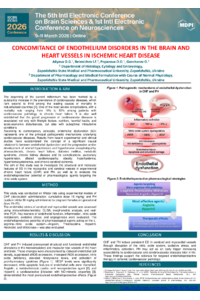
Introduction. Endothelial dysfunction (ED) is a key pathogenetic mechanism underlying cardiovascular and cerebrovascular diseases and is increasingly recognized as a common link between ischemic heart pathology and cerebral vascular impairment. In addition to postnatal risk factors, adverse intrauterine conditions, particularly prenatal hypoxia (PH), may program long-term endothelial alterations. The aim of this study was to investigate the structural and molecular features of ED in the myocardial and cerebral vessels in experimental chronic heart failure (CHF) and PH, as well as to evaluate the endothelioprotective potential of pharmacological agents targeting the nitric oxide system.
Methods. This study was conducted on Wistar rats using experimental models of CHF (doxorubicin administration, cumulative dose 15 mg/kg) and PH (sodium nitrite 50 mg/kg administered to pregnant females on gestational days 16–21). The endothelial status of cerebral and myocardial vessels was assessed using immunohistochemistry, ELISA, morphometric analysis, and real-time PCR. Key markers of endothelial function, inflammation, nitric oxide metabolism, oxidative stress, and angiogenesis were evaluated. The endothelioprotective potential of nitric oxide-modulating pharmacological agents was also evaluated.
Results. CHF and PH induced pronounced structural and functional endothelial alterations in the microcirculatory and muscular-type vessels of the heart and brain. These changes were characterized by reduced endothelial cell density, suppressed eNOS expression, increased iNOS expression, nitric oxide deficiency, elevated nitrotyrosine levels, and activation of proinflammatory cytokines. VEGF levels were significantly decreased, while apoptotic features of endothelial cells were intensified. Angiolin and Hypertril demonstrated the most pronounced endothelioprotective effects among the tested agents.
Conclusions. CHF and PH induce persistent ED in cerebral and myocardial vessels through disruption of the nitric oxide system, oxidative stress, and inflammatory activation. PH may act as an early trigger increasing susceptibility to cardiovascular and cerebrovascular diseases later in life. These findings support the rationale for targeted endothelioprotective therapy in ischemic cardiovascular pathology.
Keywords
endothelial dysfunction
chronic heart failure
prenatal hypoxia
cerebral vessels
myocardial vessels
nitric oxide system
oxidative stress
vascular endothelial growth factor
inflammatory cytokines
endothelioprotection
Poster
AliyevaOG.pdf
Recurrence Network Analysis Uncovering Biomarkers of Depression from Nonlinear Dynamics underlying EEG Signals
SENSORIMOTOR ADAPTATION IN VIRTUAL ENVIRONMENTS: THE CRITICAL ROLE OF INDIVIDUAL COGNITIVE STYLE