Event submissions
EventsThe 5th International Electronic Conference on Brain Sciences & 1st International Electronic Conference on Neurosciences
Published
This submission belongs to the session S7. Systems Neuroscience of the event The 5th International Electronic Conference on Brain Sciences & 1st International Electronic Conference on Neurosciences
Published date
04 Mar, 2026
Academic Editor
'%3e%3cpath%20d='M12.6657%2010.9104C12.4185%2010.325%2012.0599%209.79327%2011.6097%209.34482C11.1609%208.89508%2010.6293%208.5365%2010.0442%208.28888C10.0389%208.28626%2010.0337%208.28495%2010.0285%208.28233C10.8446%207.69279%2011.3752%206.73249%2011.3752%205.64904C11.3752%203.8542%209.92103%202.39999%208.1262%202.39999C6.33136%202.39999%204.87715%203.8542%204.87715%205.64904C4.87715%206.73249%205.40774%207.69279%206.22393%208.28364C6.21869%208.28626%206.21345%208.28757%206.20821%208.29019C5.62129%208.5378%205.09463%208.89284%204.64265%209.34613C4.1929%209.79493%203.83432%2010.3266%203.58671%2010.9117C3.34345%2011.4845%203.21226%2012.0987%203.20023%2012.7209C3.19988%2012.7349%203.20233%2012.7488%203.20744%2012.7619C3.21255%2012.7749%203.22022%2012.7867%203.22998%2012.7968C3.23975%2012.8068%203.25142%2012.8147%203.26431%2012.8202C3.2772%2012.8256%203.29105%2012.8284%203.30504%2012.8284H4.09109C4.14874%2012.8284%204.19459%2012.7825%204.1959%2012.7262C4.2221%2011.7148%204.62823%2010.7676%205.34617%2010.0497C6.08899%209.30683%207.0755%208.89808%208.1262%208.89808C9.17689%208.89808%2010.1634%209.30683%2010.9062%2010.0497C11.6242%2010.7676%2012.0303%2011.7148%2012.0565%2012.7262C12.0578%2012.7838%2012.1037%2012.8284%2012.1613%2012.8284H12.9474C12.9613%2012.8284%2012.9752%2012.8256%2012.9881%2012.8202C13.001%2012.8147%2013.0126%2012.8068%2013.0224%2012.7968C13.0322%2012.7867%2013.0398%2012.7749%2013.0449%2012.7619C13.0501%2012.7488%2013.0525%2012.7349%2013.0522%2012.7209C13.0391%2012.0947%2012.9094%2011.4855%2012.6657%2010.9104ZM8.1262%207.9024C7.52486%207.9024%206.9589%207.6679%206.53312%207.24211C6.10733%206.81633%205.87283%206.25037%205.87283%205.64904C5.87283%205.0477%206.10733%204.48174%206.53312%204.05596C6.9589%203.63018%207.52486%203.39567%208.1262%203.39567C8.72753%203.39567%209.29349%203.63018%209.71927%204.05596C10.1451%204.48174%2010.3796%205.0477%2010.3796%205.64904C10.3796%206.25037%2010.1451%206.81633%209.71927%207.24211C9.29349%207.6679%208.72753%207.9024%208.1262%207.9024Z'%20fill='%235D1EE1'/%3e%3c/g%3e%3c/svg%3e) Vasileios T. Papaliagkas
Vasileios T. PapaliagkasCitation
Angitha Jeesis C, Jasleen Gund, Divya Sindhu Lekha, Recurrence Network Analysis Uncovering Biomarkers of Depression from Nonlinear Dynamics underlying EEG Signals, in Proceedings of The 5th International Electronic Conference on Brain Sciences & 1st International Electronic Conference on Neurosciences, 9 March–11 March 2026, MDPI: Basel, Switzerland
Share
Email
Facebook
Twitter
LinkedIn
Recurrence Network Analysis Uncovering Biomarkers of Depression from Nonlinear Dynamics underlying EEG Signals
'%3e%3cpath%20d='M12.6647%2010.9104C12.4176%2010.325%2012.0589%209.7933%2011.6088%209.34485C11.16%208.89511%2010.6283%208.53653%2010.0432%208.28891C10.038%208.28629%2010.0327%208.28498%2010.0275%208.28236C10.8437%207.69282%2011.3743%206.73252%2011.3743%205.64907C11.3743%203.85423%209.92005%202.40002%208.12522%202.40002C6.33038%202.40002%204.87618%203.85423%204.87618%205.64907C4.87618%206.73252%205.40677%207.69282%206.22296%208.28367C6.21772%208.28629%206.21248%208.2876%206.20724%208.29022C5.62031%208.53783%205.09365%208.89287%204.64167%209.34616C4.19192%209.79496%203.83334%2010.3266%203.58573%2010.9117C3.34247%2011.4846%203.21128%2012.0987%203.19925%2012.721C3.1989%2012.735%203.20135%2012.7489%203.20646%2012.7619C3.21157%2012.7749%203.21924%2012.7868%203.22901%2012.7968C3.23877%2012.8068%203.25045%2012.8148%203.26334%2012.8202C3.27623%2012.8256%203.29007%2012.8284%203.30406%2012.8284H4.09012C4.14776%2012.8284%204.19362%2012.7825%204.19493%2012.7262C4.22113%2011.7148%204.62726%2010.7676%205.34519%2010.0497C6.08802%209.30686%207.07452%208.89811%208.12522%208.89811C9.17592%208.89811%2010.1624%209.30686%2010.9052%2010.0497C11.6232%2010.7676%2012.0293%2011.7148%2012.0555%2012.7262C12.0568%2012.7839%2012.1027%2012.8284%2012.1603%2012.8284H12.9464C12.9604%2012.8284%2012.9742%2012.8256%2012.9871%2012.8202C13%2012.8148%2013.0117%2012.8068%2013.0214%2012.7968C13.0312%2012.7868%2013.0389%2012.7749%2013.044%2012.7619C13.0491%2012.7489%2013.0515%2012.735%2013.0512%2012.721C13.0381%2012.0947%2012.9084%2011.4856%2012.6647%2010.9104ZM8.12522%207.90243C7.52388%207.90243%206.95792%207.66793%206.53214%207.24215C6.10636%206.81636%205.87185%206.2504%205.87185%205.64907C5.87185%205.04773%206.10636%204.48177%206.53214%204.05599C6.95792%203.63021%207.52388%203.3957%208.12522%203.3957C8.72655%203.3957%209.29252%203.63021%209.7183%204.05599C10.1441%204.48177%2010.3786%205.04773%2010.3786%205.64907C10.3786%206.2504%2010.1441%206.81636%209.7183%207.24215C9.29252%207.66793%208.72655%207.90243%208.12522%207.90243Z'%20fill='%235D1EE1'/%3e%3c/g%3e%3c/svg%3e)
Angitha Jeesis C 1
Jasleen Gund 2
Divya Sindhu Lekha 1
1. Department of Computer Science and Engineering, IIIT Kottayam, Kottayam - 686635, Kerala, India., India
2. Amity Institute of Biotechnology, Amity University, Noida-201313, Uttar Pradesh, India., India
Abstract
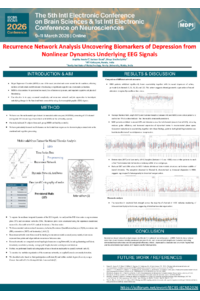
Introduction: Major Depressive Disorder (MDD) is one of the most prevalent and severe mental health condition, affecting millions of individuals worldwide and often leading to significant cognitive and emotional dysfunction. MDD is characterized by persistent low mood, loss of interest or pleasure, and impaired cognitive and physical functioning. Our objective is to apply advanced complexity and recurrence network analysis approaches to investigate underlying changes in functional brain connectivity using electroencephalographic (EEG) signals.
Methods: We used the multi-modal open dataset for mental-disorder analysis (MODMA), consisting of 128-channel resting-state EEG recordings of individuals with MDD and those of healthy controls. We have particularly focussed on channels in the frontal brain region as it is known to play a crucial role in emotional and cognitive processing. After pre-processing, power spectral density (PSD) and Lempel–Ziv (LZ) complexity analysis were applied to distinguish MDD subjects from healthy controls. We performed t-tests to identify significant channels. We then constructed recurrence networks to capture the nonlinear temporal dynamics of EEG activity in these significant frontal channels. Then, we computed various network measures, including Recurrence Quantification Analysis (RQA), recurrence rate (RR), determinism (DET), and laminarity (LAM), to characterize the resulting recurrence network. Further, we performed functional cartography of nodes based on modularity to quantify network hubs.
Results: The results revealed frontal asymmetry with several frontal channels exhibiting significant variations in oscillatory power and signal complexity in MDD. The recurrence networks represent the complex interrelationships among recurring patterns of EEG brain activity over time. We observed that functional cartography applied for hub classification in the constructed recurrence networks provides a powerful framework for quantitative analysis and unveiling network-based signatures underlying the nonlinear dynamics of EEG signals.
Conclusions: The identification of such EEG-based network markers could facilitate early detection and prediction of MDD severity.
Keywords
MDD
Signal complexity
Recurrence Networks
Network Topology
Hub-node classification
Poster
Poster Template.pptx.pdf
Interactive Brain Interface for Multimodal EEG Visualization and Disease-Specific Neural Dynamics
CONCOMITANCE OF ENDOTHELIUM DISORDERS IN THE BRAIN AND HEART VESSELS IN ISCHEMIC HEART DISEASE