Event submissions
EventsThe 5th International Electronic Conference on Brain Sciences & 1st International Electronic Conference on Neurosciences
Published
This submission belongs to the session S7. Systems Neuroscience of the event The 5th International Electronic Conference on Brain Sciences & 1st International Electronic Conference on Neurosciences
Published date
04 Mar, 2026
Academic Editor
'%3e%3cpath%20d='M12.6657%2010.9104C12.4185%2010.325%2012.0599%209.79327%2011.6097%209.34482C11.1609%208.89508%2010.6293%208.5365%2010.0442%208.28888C10.0389%208.28626%2010.0337%208.28495%2010.0285%208.28233C10.8446%207.69279%2011.3752%206.73249%2011.3752%205.64904C11.3752%203.8542%209.92103%202.39999%208.1262%202.39999C6.33136%202.39999%204.87715%203.8542%204.87715%205.64904C4.87715%206.73249%205.40774%207.69279%206.22393%208.28364C6.21869%208.28626%206.21345%208.28757%206.20821%208.29019C5.62129%208.5378%205.09463%208.89284%204.64265%209.34613C4.1929%209.79493%203.83432%2010.3266%203.58671%2010.9117C3.34345%2011.4845%203.21226%2012.0987%203.20023%2012.7209C3.19988%2012.7349%203.20233%2012.7488%203.20744%2012.7619C3.21255%2012.7749%203.22022%2012.7867%203.22998%2012.7968C3.23975%2012.8068%203.25142%2012.8147%203.26431%2012.8202C3.2772%2012.8256%203.29105%2012.8284%203.30504%2012.8284H4.09109C4.14874%2012.8284%204.19459%2012.7825%204.1959%2012.7262C4.2221%2011.7148%204.62823%2010.7676%205.34617%2010.0497C6.08899%209.30683%207.0755%208.89808%208.1262%208.89808C9.17689%208.89808%2010.1634%209.30683%2010.9062%2010.0497C11.6242%2010.7676%2012.0303%2011.7148%2012.0565%2012.7262C12.0578%2012.7838%2012.1037%2012.8284%2012.1613%2012.8284H12.9474C12.9613%2012.8284%2012.9752%2012.8256%2012.9881%2012.8202C13.001%2012.8147%2013.0126%2012.8068%2013.0224%2012.7968C13.0322%2012.7867%2013.0398%2012.7749%2013.0449%2012.7619C13.0501%2012.7488%2013.0525%2012.7349%2013.0522%2012.7209C13.0391%2012.0947%2012.9094%2011.4855%2012.6657%2010.9104ZM8.1262%207.9024C7.52486%207.9024%206.9589%207.6679%206.53312%207.24211C6.10733%206.81633%205.87283%206.25037%205.87283%205.64904C5.87283%205.0477%206.10733%204.48174%206.53312%204.05596C6.9589%203.63018%207.52486%203.39567%208.1262%203.39567C8.72753%203.39567%209.29349%203.63018%209.71927%204.05596C10.1451%204.48174%2010.3796%205.0477%2010.3796%205.64904C10.3796%206.25037%2010.1451%206.81633%209.71927%207.24211C9.29349%207.6679%208.72753%207.9024%208.1262%207.9024Z'%20fill='%235D1EE1'/%3e%3c/g%3e%3c/svg%3e) Cristian Randieri
Cristian RandieriCitation
Margarita Nikulina, Anna Shulman, Maxim Baltin, Tatyana Baltina, Angelina Zheltukhina, SENSORIMOTOR ADAPTATION IN VIRTUAL ENVIRONMENTS: THE CRITICAL ROLE OF INDIVIDUAL COGNITIVE STYLE, in Proceedings of The 5th International Electronic Conference on Brain Sciences & 1st International Electronic Conference on Neurosciences, 9 March–11 March 2026, MDPI: Basel, Switzerland
Share
Email
Facebook
Twitter
LinkedIn
SENSORIMOTOR ADAPTATION IN VIRTUAL ENVIRONMENTS: THE CRITICAL ROLE OF INDIVIDUAL COGNITIVE STYLE

Margarita Nikulina 1
'%3e%3cpath%20d='M12.6647%2010.9104C12.4176%2010.325%2012.0589%209.7933%2011.6088%209.34485C11.16%208.89511%2010.6283%208.53653%2010.0432%208.28891C10.038%208.28629%2010.0327%208.28498%2010.0275%208.28236C10.8437%207.69282%2011.3743%206.73252%2011.3743%205.64907C11.3743%203.85423%209.92005%202.40002%208.12522%202.40002C6.33038%202.40002%204.87618%203.85423%204.87618%205.64907C4.87618%206.73252%205.40677%207.69282%206.22296%208.28367C6.21772%208.28629%206.21248%208.2876%206.20724%208.29022C5.62031%208.53783%205.09365%208.89287%204.64167%209.34616C4.19192%209.79496%203.83334%2010.3266%203.58573%2010.9117C3.34247%2011.4846%203.21128%2012.0987%203.19925%2012.721C3.1989%2012.735%203.20135%2012.7489%203.20646%2012.7619C3.21157%2012.7749%203.21924%2012.7868%203.22901%2012.7968C3.23877%2012.8068%203.25045%2012.8148%203.26334%2012.8202C3.27623%2012.8256%203.29007%2012.8284%203.30406%2012.8284H4.09012C4.14776%2012.8284%204.19362%2012.7825%204.19493%2012.7262C4.22113%2011.7148%204.62726%2010.7676%205.34519%2010.0497C6.08802%209.30686%207.07452%208.89811%208.12522%208.89811C9.17592%208.89811%2010.1624%209.30686%2010.9052%2010.0497C11.6232%2010.7676%2012.0293%2011.7148%2012.0555%2012.7262C12.0568%2012.7839%2012.1027%2012.8284%2012.1603%2012.8284H12.9464C12.9604%2012.8284%2012.9742%2012.8256%2012.9871%2012.8202C13%2012.8148%2013.0117%2012.8068%2013.0214%2012.7968C13.0312%2012.7868%2013.0389%2012.7749%2013.044%2012.7619C13.0491%2012.7489%2013.0515%2012.735%2013.0512%2012.721C13.0381%2012.0947%2012.9084%2011.4856%2012.6647%2010.9104ZM8.12522%207.90243C7.52388%207.90243%206.95792%207.66793%206.53214%207.24215C6.10636%206.81636%205.87185%206.2504%205.87185%205.64907C5.87185%205.04773%206.10636%204.48177%206.53214%204.05599C6.95792%203.63021%207.52388%203.3957%208.12522%203.3957C8.72655%203.3957%209.29252%203.63021%209.7183%204.05599C10.1441%204.48177%2010.3786%205.04773%2010.3786%205.64907C10.3786%206.2504%2010.1441%206.81636%209.7183%207.24215C9.29252%207.66793%208.72655%207.90243%208.12522%207.90243Z'%20fill='%235D1EE1'/%3e%3c/g%3e%3c/svg%3e)
Anna Shulman 2
Angelina Zheltukhina 3
Maxim Baltin 1
Tatyana Baltina 3
1. Sport science department, Sirius University of Science and Technology, Sirius Federal territory, 354349, Olympic Ave, 1, Russia, Russia
2. Scientific Research Laboratory "Mechanobiology", Kazan Federal University, Kazan, 420008, Kremlevskaya, 18, Russia, Russia
3. Department of Human and Animal Physiology, Kazan Federal University, Kazan, 420008, Kremlevskaya, 18, Russia, Russia
Abstract
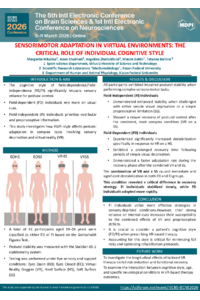
Introduction: It has been established that the cognitive style of field dependence/field independence (FD/FI) significantly influences sensory reliance in postural control. Individuals with FD appear to rely more on vision, whereas those with FI prioritize vestibular and proprioceptive inputs. The current study aims to investigate the impact of this cognitive style on postural adaptation in complex tasks involving sensory deprivation and virtual reality.
Methods: A total of 41 participants aged 19–26 years were classified as either FD or FI based on the Gottschaldt Figures Test. Their postural stability was assessed using stabilometry (Stabilan-01-2) under various conditions: eyes open (EO), eyes closed (EC), virtual reality goggles (VR), hard surface (HS), and soft surface (SS).
Results: All participants showed impaired postural control during complex tasks. Individuals with FI showed enhanced stability when faced with either simple visual deprivation or proprioceptive limitation. In contrast, individuals with FD demonstrated increased destabilization in response to virtual reality on a firm surface, with a prolonged recovery time after visual deprivation. However, when virtual reality was combined with a soft surface, both groups exhibited immediate destabilization. Interestingly, FI individuals showed a slower recovery after the test, while FD individuals displayed a faster adaptation rate.
Conclusion: It has been shown that FI individuals use more effective strategies in sensory-deprived conditions. However, their strong reliance on internal cues makes them more susceptible to the combined effects of VR and proprioceptive deficits. It is crucial to consider a patient's cognitive style when prescribing VR-based therapy, as this can be critical in minimizing fall risks and optimizing rehabilitation protocols.
This study was supported by the Russian Science Foundation (grant №25-15-20048).
Keywords
postural stability
cognitive style
stabilography
virtual reality
Poster
sciforum-158088 Nikulina_Poster.pdf
CONCOMITANCE OF ENDOTHELIUM DISORDERS IN THE BRAIN AND HEART VESSELS IN ISCHEMIC HEART DISEASE
EEG markers of cognitive load and mental fatigue in university students: a systematic review