Event submissions
Published
 10.3390/HMAM2-14152 (registering DOI)
 This submission belongs to the session AMP. Advanced Manufacturing posters of the event Holography Meets Advanced Manufacturing
Published date
13 Mar, 2023
Academic Editor
'%3e%3cpath%20d='M12.6657%2010.9104C12.4185%2010.325%2012.0599%209.79327%2011.6097%209.34482C11.1609%208.89508%2010.6293%208.5365%2010.0442%208.28888C10.0389%208.28626%2010.0337%208.28495%2010.0285%208.28233C10.8446%207.69279%2011.3752%206.73249%2011.3752%205.64904C11.3752%203.8542%209.92103%202.39999%208.1262%202.39999C6.33136%202.39999%204.87715%203.8542%204.87715%205.64904C4.87715%206.73249%205.40774%207.69279%206.22393%208.28364C6.21869%208.28626%206.21345%208.28757%206.20821%208.29019C5.62129%208.5378%205.09463%208.89284%204.64265%209.34613C4.1929%209.79493%203.83432%2010.3266%203.58671%2010.9117C3.34345%2011.4845%203.21226%2012.0987%203.20023%2012.7209C3.19988%2012.7349%203.20233%2012.7488%203.20744%2012.7619C3.21255%2012.7749%203.22022%2012.7867%203.22998%2012.7968C3.23975%2012.8068%203.25142%2012.8147%203.26431%2012.8202C3.2772%2012.8256%203.29105%2012.8284%203.30504%2012.8284H4.09109C4.14874%2012.8284%204.19459%2012.7825%204.1959%2012.7262C4.2221%2011.7148%204.62823%2010.7676%205.34617%2010.0497C6.08899%209.30683%207.0755%208.89808%208.1262%208.89808C9.17689%208.89808%2010.1634%209.30683%2010.9062%2010.0497C11.6242%2010.7676%2012.0303%2011.7148%2012.0565%2012.7262C12.0578%2012.7838%2012.1037%2012.8284%2012.1613%2012.8284H12.9474C12.9613%2012.8284%2012.9752%2012.8256%2012.9881%2012.8202C13.001%2012.8147%2013.0126%2012.8068%2013.0224%2012.7968C13.0322%2012.7867%2013.0398%2012.7749%2013.0449%2012.7619C13.0501%2012.7488%2013.0525%2012.7349%2013.0522%2012.7209C13.0391%2012.0947%2012.9094%2011.4855%2012.6657%2010.9104ZM8.1262%207.9024C7.52486%207.9024%206.9589%207.6679%206.53312%207.24211C6.10733%206.81633%205.87283%206.25037%205.87283%205.64904C5.87283%205.0477%206.10733%204.48174%206.53312%204.05596C6.9589%203.63018%207.52486%203.39567%208.1262%203.39567C8.72753%203.39567%209.29349%203.63018%209.71927%204.05596C10.1451%204.48174%2010.3796%205.0477%2010.3796%205.64904C10.3796%206.25037%2010.1451%206.81633%209.71927%207.24211C9.29349%207.6679%208.72753%207.9024%208.1262%207.9024Z'%20fill='%235D1EE1'/%3e%3c/g%3e%3c/svg%3e) Kaupo Kukli
Kaupo KukliCitation
Savvas Papamakarios, Odisseas Tsilipakos, Anastasios Koulouklidis, Stelios Tzortzakis, Maria Kafesaki, Maria Farsari, Fabrication and analysis of 3D low THz metamaterials, in Proceedings of Holography Meets Advanced Manufacturing, 20 February–22 February 2023, MDPI: Basel, Switzerland, doi: 10.3390/HMAM2-14152
Share
Email
Facebook
Twitter
LinkedIn
Fabrication and analysis of 3D low THz metamaterials
'%3e%3cpath%20d='M12.6647%2010.9104C12.4176%2010.325%2012.0589%209.7933%2011.6088%209.34485C11.16%208.89511%2010.6283%208.53653%2010.0432%208.28891C10.038%208.28629%2010.0327%208.28498%2010.0275%208.28236C10.8437%207.69282%2011.3743%206.73252%2011.3743%205.64907C11.3743%203.85423%209.92005%202.40002%208.12522%202.40002C6.33038%202.40002%204.87618%203.85423%204.87618%205.64907C4.87618%206.73252%205.40677%207.69282%206.22296%208.28367C6.21772%208.28629%206.21248%208.2876%206.20724%208.29022C5.62031%208.53783%205.09365%208.89287%204.64167%209.34616C4.19192%209.79496%203.83334%2010.3266%203.58573%2010.9117C3.34247%2011.4846%203.21128%2012.0987%203.19925%2012.721C3.1989%2012.735%203.20135%2012.7489%203.20646%2012.7619C3.21157%2012.7749%203.21924%2012.7868%203.22901%2012.7968C3.23877%2012.8068%203.25045%2012.8148%203.26334%2012.8202C3.27623%2012.8256%203.29007%2012.8284%203.30406%2012.8284H4.09012C4.14776%2012.8284%204.19362%2012.7825%204.19493%2012.7262C4.22113%2011.7148%204.62726%2010.7676%205.34519%2010.0497C6.08802%209.30686%207.07452%208.89811%208.12522%208.89811C9.17592%208.89811%2010.1624%209.30686%2010.9052%2010.0497C11.6232%2010.7676%2012.0293%2011.7148%2012.0555%2012.7262C12.0568%2012.7839%2012.1027%2012.8284%2012.1603%2012.8284H12.9464C12.9604%2012.8284%2012.9742%2012.8256%2012.9871%2012.8202C13%2012.8148%2013.0117%2012.8068%2013.0214%2012.7968C13.0312%2012.7868%2013.0389%2012.7749%2013.044%2012.7619C13.0491%2012.7489%2013.0515%2012.735%2013.0512%2012.721C13.0381%2012.0947%2012.9084%2011.4856%2012.6647%2010.9104ZM8.12522%207.90243C7.52388%207.90243%206.95792%207.66793%206.53214%207.24215C6.10636%206.81636%205.87185%206.2504%205.87185%205.64907C5.87185%205.04773%206.10636%204.48177%206.53214%204.05599C6.95792%203.63021%207.52388%203.3957%208.12522%203.3957C8.72655%203.3957%209.29252%203.63021%209.7183%204.05599C10.1441%204.48177%2010.3786%205.04773%2010.3786%205.64907C10.3786%206.2504%2010.1441%206.81636%209.7183%207.24215C9.29252%207.66793%208.72655%207.90243%208.12522%207.90243Z'%20fill='%235D1EE1'/%3e%3c/g%3e%3c/svg%3e)
Savvas Papamakarios 1

Odisseas Tsilipakos 2
Anastasios Koulouklidis 2

Stelios Tzortzakis 2
Maria Kafesaki 2
Maria Farsari 2
1. 1) Department of Physics, University of Crete, Vassilika Vouton, Heraklion, 71409, Greece
2) Institute of Electronic Structure and Laser, Foundation for Research and Technology – Hellas (FORTH – IESL) , 100 Nikolaou Plastira Street, Heraklio, 70013, Gree
2. Institute of Electronic Structure and Laser, Foundation for Research and Technology – Hellas (FORTH – IESL) , 100 Nikolaou Plastira Street, Heraklio, 70013, Greece
Abstract
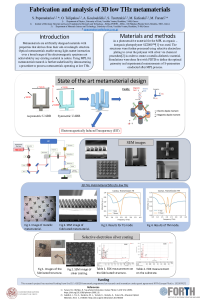
The creation of fascinating optical effects such as negative refractive, optical magnetism, and cloaking has become a human dream since the late 1940s, when artificially designed materials, so-called optical metamaterials, were investigated. They are therefore highly interesting for many future applications in many fields. Fabrication of 3D optical metamaterials, which would enable the use of their full potential, remains challenging due to the limitations of conventional manufacturing techniques. An approach that has been proved to be suitable to overcome this challenge is multi-photon lithography (MPL)[1], which is a true 3D printing technique with high resolution down to sub-100 nm.
In this work, the high potential of using MPL for metamaterial research is further underlined by demonstrating a procedure to process metamaterials operating at low THz frequency (1-10 THz) and generate novel devices as perfect absorbers and electromagnetic waves attenuator. In these frequencies there is no natural element that can interact with electromagnetic fields. Simulation by Finite Differential Time Domain (FDTD) method were done to design the materials’ geometry giving the optimal dimensions and properties for the structure. As a photosensitive material for the MPL an organic – inorganic photopolymer SZ2080™ was used. After MPL processing, the structures were further processed using selective electroless plating to cover the polymer with silver via chemical procedure, so the spectral characterization (absorbance, transmittance, reflectance) can be done at THz frequencies.
[1] Farsari, M., Chichkov, B. Two-photon fabrication. Nature Photon 3, 450–452 (2009), https://doi.org/10.1038/nphoton.2009.131
Keywords
multiphoton lithography
THz metamaterials
FDTD
silver coating
Manuscript
papamakarios_online_p.pdf
Poster
poster_papamakarios.pdf
Single Shot Lensless Interferenceless Phase Imaging of Biochemical Samples Using Synchrotron Near Infrared Beam
Incoherent digital holography for multidimensional motion-picture imaging